Cabarete became famous for wind before anyone had heard of surf camps. Windsurfers found it in the mid-1980s, kitesurfers took over from the late 1990s, and today it is the busiest kite town in the Caribbean. This guide to kitesurfing in the Dominican Republic covers what you actually need to plan a trip: which spot suits your level, how strong the wind really is, which months are worth booking, how lessons work in town, and how to get here without wasting a day in transit.
One thing up front. Swell is a surf and wingfoil retreat, not a kite school. We have run it in the centre of Cabarete since 2009, a few minutes’ walk from the bay, and plenty of our guests kite in the afternoons after a morning surf; when they do, we book their course with the school we trust. So this is a locals’ guide with a declared bias towards Cabarete.
Why Cabarete is the kitesurfing capital of the Dominican Republic
Cabarete works because the trade wind arrives almost every afternoon, blows side-onshore so a dropped kite drifts you back to the beach rather than out to sea, and lands on wide sandy bays with room for hundreds of riders. Add warm water, a dozen schools and a real town behind the beach, and you have the most complete kite destination in the Caribbean.
The wind is thermal. The Caribbean trades are driven by heating over the land, so they build through the morning, pick up properly after lunch and peak around 3pm. They accelerate along the north coast and are strongest right at Cabarete. The geography matters too: the reef off the bay gives you flat water inside and proper waves outside, and the river mouth at La Boca gives you glass.
If you want the case for Cabarete in one glance:
- Steady, safe, side-onshore trade winds
- Wide sandy beaches with room for hundreds of kites
- Warm air and 27°C water, board shorts all year
- A dozen schools, rentals and kite shops in one town
- Flat water, waves and downwinders within 15 minutes
- 25 minutes from an international airport
- Surf, canyoning and day trips on the no-wind days
- Restaurants and bars on the beach, and a party if you want one
The side-onshore direction is the safety feature most visitors underestimate. If your kite goes down or a line snaps, you float in, not out. For anyone learning, or returning to the sport after a few years off, that changes the whole experience.
The best kitesurfing spots in the Dominican Republic
The five spots that matter are all in or around Cabarete: La Boca lagoon for flat water, Cabarete Bay and Kite Beach for a mix of flat and waves, and Playa Encuentro for wave riding. Las Terrenas on the Samaná peninsula and Punta Rucia to the west are worth a few days if you want quieter water, but neither has Cabarete’s consistency or infrastructure.

The Cabarete spots from east to west: La Boca, Cabarete Bay, Kite Beach, Playa Encuentro.
| Spot | Water | Level | From Swell | Watch out for |
|---|---|---|---|---|
| La Boca | Butter-flat river mouth | Intermediate / expert | 15 min east by car or moto-taxi | Floating logs after rain; a small area that gets crowded |
| Cabarete Bay (Bozo / La Goleta) | Flat to choppy inside the reef, waves on the reef | All levels | A few minutes’ walk | Wind shadow near the windsurf schools at the east end; heavy shorebreak at Bozo Feb–Apr |
| Kite Beach | Flat to choppy inside, waves outside | All levels | Short ride or 15–20 min walk west along the beach | Beach shrinks with summer erosion |
| Playa Encuentro | Waves | Intermediate / expert | 10 min west; or a 15–20 min downwinder from the bay | Sea urchins on the reef; few landing beaches on the way down |
| Las Terrenas | Turquoise flat water | All levels | A separate trip, Samaná peninsula | Less wind consistency than Cabarete |
Levels are for riding unassisted. Complete beginners learn inside the reef at Cabarete Bay or Kite Beach with a school, never at La Boca or Encuentro.
La Boca. The lagoon where the Río Yassica meets the sea, 15 minutes east of town. Small, sheltered and flat enough that freestylers treat it as a training ground. Bring your own pump, and when you are done, ride the downwinder back to Cabarete instead of taking a taxi.
Luis Alberto Cruz, nephew of Sipriana, Swell’s longest-serving staff member, riding the flat water at La Boca.
Cabarete Bay. The main beach is really three sections. The eastern end is windsurf territory with a wind shadow close to shore, so kites stay away. From the Ocean One buildings west you are on Bozo Beach, where the wind is clean and steady. Another 200–300 metres west is La Goleta, with reasonably flat water inside the reef and fun waves on it. This is where most people start, and where the best-established schools teach.
Kite Beach. The world-famous one, a 15–20 minute walk west along the sand. Same recipe as the bay, flat inside and waves outside, with more space and a strong local scene. Many of the best riders in the country call it home, which tells you something about the conditions.
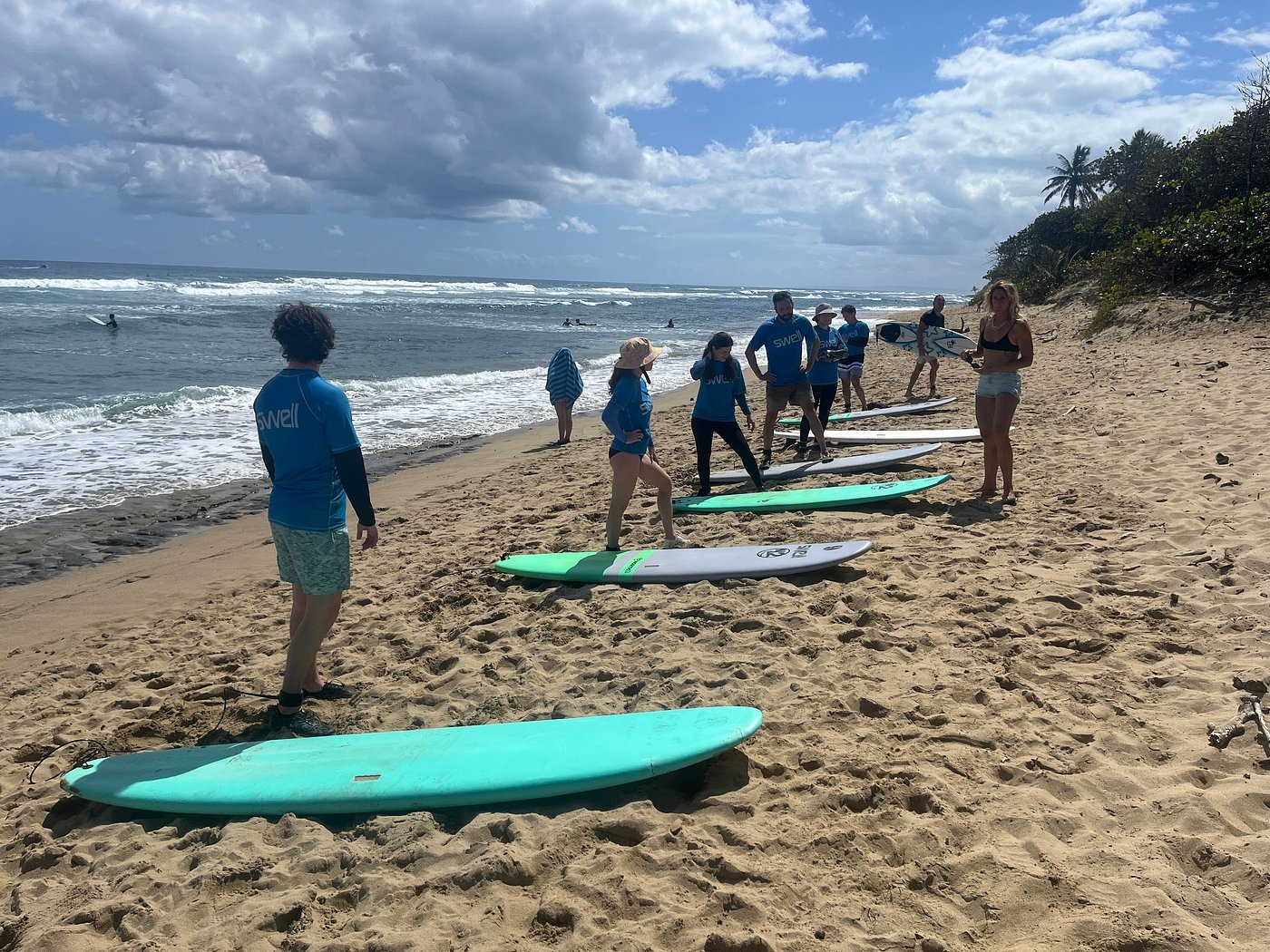
Playa Encuentro. This is the surf beach we teach on every morning, and it has a second life in the afternoon when the wind arrives and wave kiters take over. Good riders do the downwinder from the bay or Kite Beach, 15–20 minutes of waves the whole way. It is not a spot to learn: there are urchins on the reef, and landing a kite is easiest on the small patch of sand just west of the main peak.
Wind: what to expect and when it blows
Expect 16–22 knots of side-onshore trade wind on a normal afternoon in Cabarete, building from around midday and peaking at roughly 3pm. Mornings are usually light, which is why Cabarete works so well as a two-sport destination: surf the glassy waves early, kite when the wind fills in.
Two practical notes. First, forecast sites tend to under-read Cabarete by four to six knots because they do not model the thermal acceleration along the coast; if Windguru shows 14, plan for 18–20 on the beach. Second, there is no true off-season. Any month can deliver 20 or more windy days, but some months stack the odds far better than others, which is what the calendar below is for.
Live wind over the north coast. Remember the beach usually reads four to six knots higher than the model.
And this is what it looks like on a normal windy afternoon, filmed by a local pro:
When to go kitesurfing in the Dominican Republic: month by month
June, July and August are the most reliable months, with 20–25 days a month of 14 knots or more. December through May is a good second tier at 12–15 windy days a month. September to November is the quiet stretch, 5–12 windy days, and the time to combine kiting with surfing or skip it altogether.
| Cabarete | Jan | Feb | Mar | Apr | May | Jun | Jul | Aug | Sep | Oct | Nov | Dec |
|---|---|---|---|---|---|---|---|---|---|---|---|---|
| Windy days (14+ kt) | 12–15 | 12–15 | 12–15 | 12–15 | 12–15 | 20–25 | 20–25 | 20–25 | 5–12 | 5–12 | 5–12 | 12–15 |
| Surf on the same trip | Big | Big | Big | Big | Mellow | Mellow | Mellow | Mellow | Mellow | Mellow | Building | Big |
February to April combine the best surf with decent wind, but Bozo Beach can have a heavy shorebreak in those months. Launch and land further west towards La Goleta or at Kite Beach.
For the broader weather picture, rain, temperatures and what the town feels like in each season, see our guide to the weather in Cabarete and when to visit.
Learning to kitesurf in Cabarete: schools, lessons and safety
There are a dozen or more kite schools in Cabarete, from long-established operations to one-man outfits, and the gap between them is large. The school we have sent guests to for years runs structured courses with qualified instructors, current equipment in a range of sizes, and helmets and impact vests as standard. Whichever school you choose, those four things are the checklist.
The established schools are not the cheapest per hour. In our experience they are usually the cheapest per skill learned, because progress with a good instructor and a kite that flies properly is faster and safer than a bargain course on tired gear. A badly flying kite is dangerous, and a friend offering to teach you on his is the quickest way to wreck his kite or your week. Private teaching by anyone not affiliated with a licensed school is banned on Cabarete’s beaches for exactly that reason.

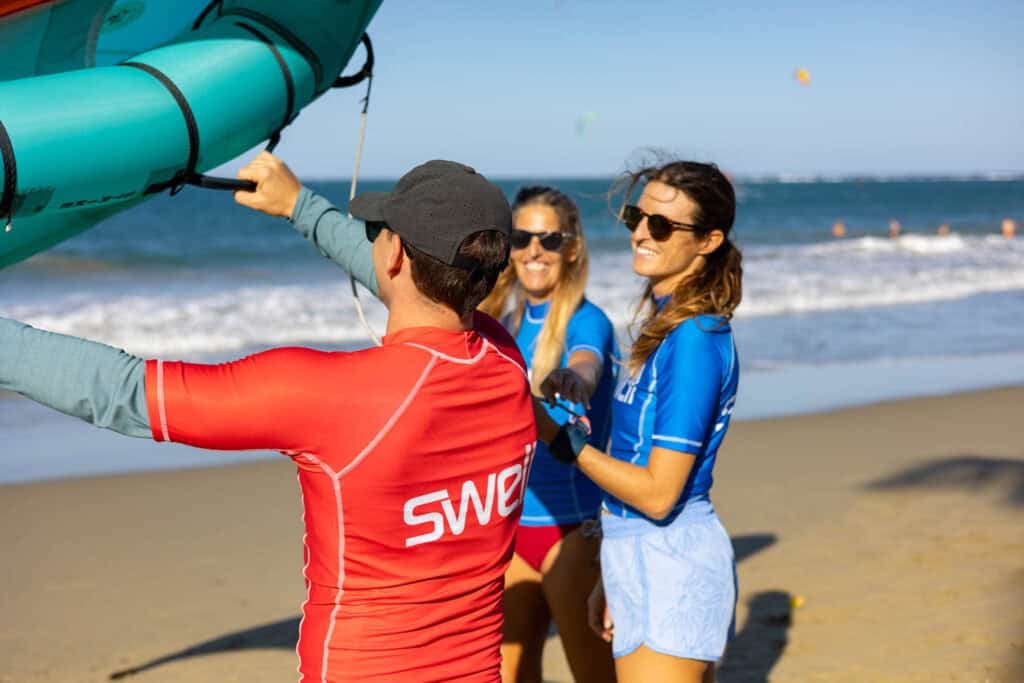
If you stay with us, tell us when you book and we arrange your kite course for you with the school we trust, from a complete-beginner course to wave riding, jumping or foiling sessions for riders who already have the basics. Lessons run in the afternoon, so they sit neatly after a morning surf session.
Budget three to four afternoons for a first course. Most people are body-dragging on day one, up on the board by day two or three, and riding short runs by the end of a week if the wind cooperates. Lessons happen in the afternoon when the wind is up, which leaves mornings free.
Gear. Several shops in Cabarete sell new kites, boards and accessories, and the better schools sell off their fleet regularly, so buying second-hand here is realistic. Pump a used kite up and leave it for a while to find slow leaks, check the fabric is crisp rather than soft, run the full length of the lines for fraying, and test the safety release before money changes hands.
Kitesurfing or wingfoiling? What we teach at Swell, and why
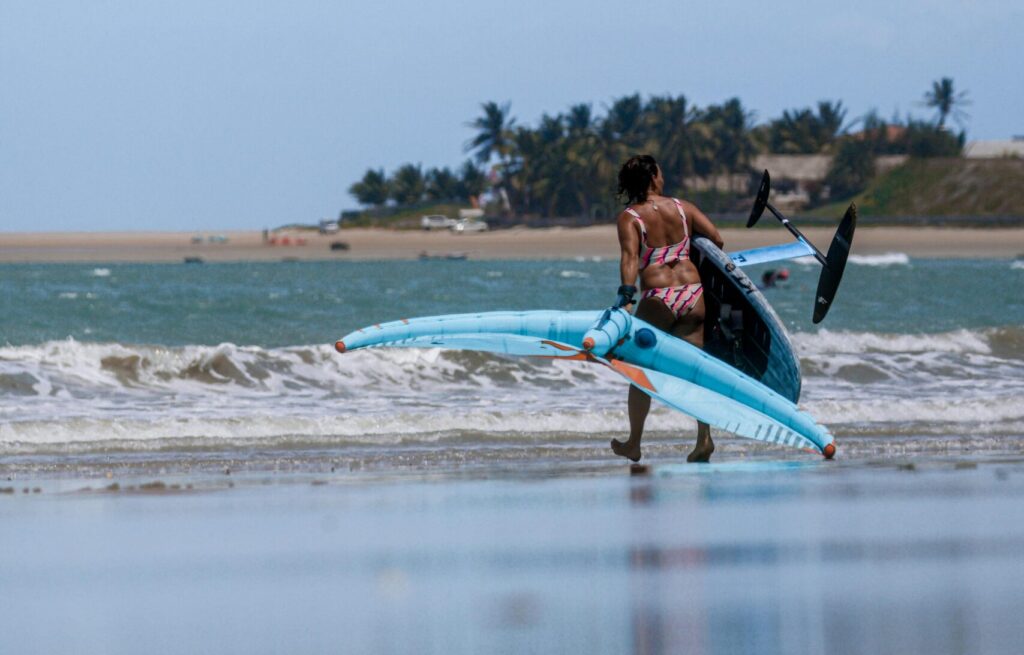
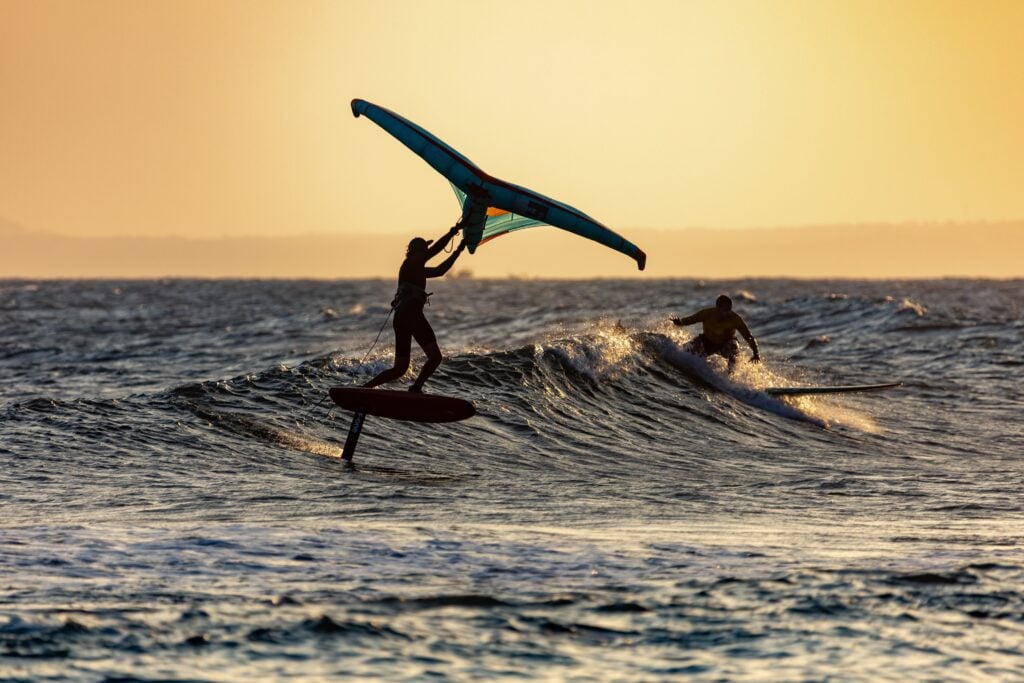
Swell teaches surfing in the mornings and wingfoiling in the afternoons. We added the wing in 2020 because it uses the same Cabarete trade wind as kiting, in the same flat water inside the reef, with far less gear, fewer lines to tangle and a gentler first week for an adult starting from zero. If you want the wind-sport half of a Cabarete holiday without committing to a full kite course, that is what our wingfoil camp is built for.
Kiting still wins on raw speed, big jumps and long downwinders, and if you already kite there is no reason to switch. If you are choosing between the two for a first trip, we compared them properly in surfing vs wingfoiling: which should you learn first, and our guide to wingfoiling in Cabarete covers the same wind, spots and seasons from the wing side.
Either way, the daily rhythm is the one Cabarete has always run on: waves before breakfast, wind after lunch, and a long table in the evening to compare notes.
Getting there and where to base yourself
Fly into Puerto Plata (POP); the beach is 25 minutes from the terminal. Santiago (STI) is the second choice at about an hour and a half, Santo Domingo (SDQ) is three to four hours, and Punta Cana (PUJ) is cheap to reach but seven hours from the north coast, so it is not a real option for a kite trip.
Direct flights into POP run from New York, Boston, Miami, Toronto and Montreal, roughly 1.5 to 4 hours, with seasonal charters from Europe. Full route options and transfer details are on our getting here page.
Stay in Cabarete itself rather than a resort down the coast. The spots, the schools and the wind forecast conversation are all here, and you can walk to the bay with a kite under your arm. That is the reason we built Swell where we did. Breakfast and dinner are eaten at one table, so you will have someone to compare wind notes with before you have unpacked.

The short version
Three things to take away. Cabarete is the place: side-onshore wind, warm water and five spots in one town make it the most complete kitesurfing destination in the Dominican Republic. June to August is the safest bet for wind, with December to May a good second choice and a surf bonus. And learn with an established school inside the reef, not with a friend or a bargain outfit on the beach.
Staying at Swell, you can do it either way: we book your kite course in town, or you learn to wingfoil with us on the same afternoons and the same water. Either way, mornings here belong to the surf.
Surf in the morning, wind in the afternoon
Tell us your dates, who is coming and whether you want surf, wingfoil or a kite course added. We will send a custom price and live availability, usually the same day.
Kitesurfing in the Dominican Republic: frequently asked questions
Where is the best place to kitesurf in the Dominican Republic?
Cabarete, on the north coast. It has steady side-onshore trade winds of 16–22 knots most afternoons, warm water all year, a dozen schools and five different spots within 15 minutes: La Boca, Cabarete Bay, Kite Beach, Playa Encuentro and, further afield, Las Terrenas. No other area in the country combines that consistency with that infrastructure.
When is the best time of year for kitesurfing in the Dominican Republic?
June, July and August are the windiest, with 20–25 days a month of 14 knots or more. December to May gives 12–15 windy days a month plus the best surf of the year. September to November is the least reliable stretch, with 5–12 windy days.
Can a complete beginner learn to kitesurf in Cabarete?
Yes. The flat water inside the reef at Cabarete Bay and Kite Beach, the side-onshore wind that brings you back to shore, and established schools with structured courses make it one of the easier places to start. Plan on three to four afternoons of lessons for a first course, and book with a licensed school rather than an individual.
How strong is the wind in Cabarete?
Typically 16–22 knots side-onshore in the afternoon, building from around midday and peaking near 3pm. Forecast sites usually show four to six knots less than you will feel on the beach because they miss the thermal acceleration along the coast.
Does Swell Surf Camp offer kitesurfing?
Swell teaches surfing in the mornings and wingfoiling in the afternoons. We do not run kite lessons ourselves, but we book kite courses for our guests with the established school we have worked with for years, a few minutes’ walk from the retreat, from first lessons to advanced sessions. Tell us when you enquire and we build it into your week.