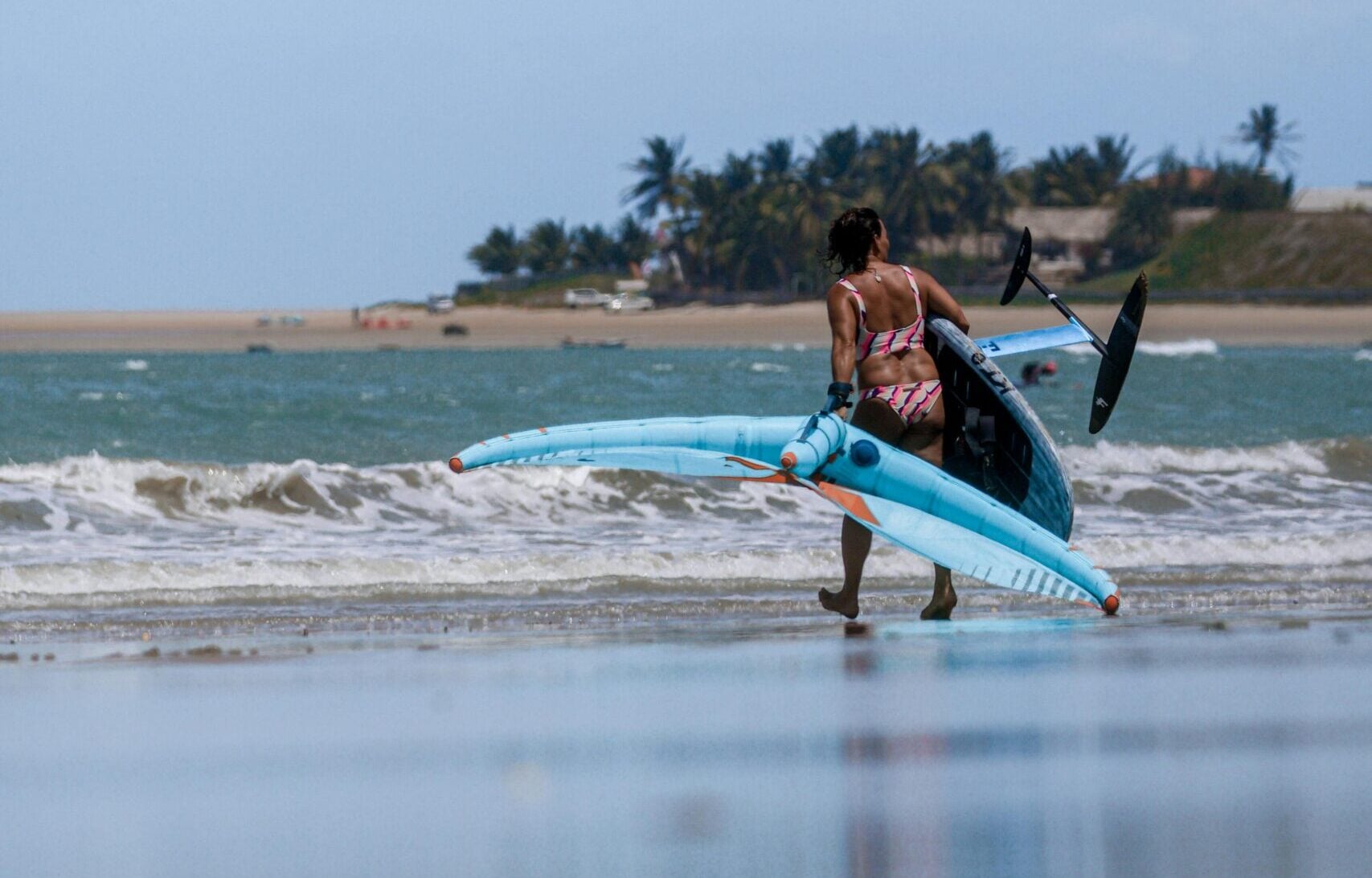
The best wingfoil spots for beginners share four things: water deep enough to clear your foil, a sand bottom, side-shore wind, and enough of it to be reliable in your travel window. Plenty of famous flat-water spots fail the first test badly. Below: eight destinations that pass, when to go to each, and three well-known places to skip on your first trip.
Most people who give up on wingfoiling don’t give up because the sport is too hard. They give up because they picked the wrong place to start. A gusty lake, an offshore breeze, a bottom you keep hitting with the foil — any one of these turns a week that should be exhilarating into a week of walking back upwind.
The frustrating part is that the advice out there is often wrong. Search for the best wingfoil spots for beginners and you’ll get lists built for kiteboarding, recommending shallow water precisely because it’s shallow. That logic works with a fin. It does not work with a mast under your board.
We’ve been teaching adult beginners in Cabarete since 2009 — over 6,000 guests, average age 39 — and we teach both surfing and wingfoiling, so we spend a lot of time explaining why the conditions that suit one don’t always suit the other. Here’s what actually matters, and where to find it.
What makes a wingfoil spot good for beginners?
A beginner-friendly wingfoil spot needs water deep enough to clear the foil across the whole riding area — chest deep as an absolute minimum — over a sand bottom, with side-shore wind between roughly 12 and 20 knots that shows up reliably during your trip. Warm water and on-site coaching turn a workable spot into a good one.
Notice what isn’t on that list: waves, scenery, or a famous name. Those matter later. In your first week they’re irrelevant, and chasing them is how people end up somewhere unsuitable.
The 8 best wingfoil spots for beginners
We should be upfront: we run a wingfoil and surf camp in Cabarete, which is one of the eight destinations below. We have a commercial interest in you choosing it. We’ve handled that by judging every spot against the same five criteria, giving Cabarete no more space than the others, and being honest about where it loses — the wind is unreliable in September and October, and there’s reef on parts of the coast. Where another destination is genuinely better at something, we’ve said so. Read us as informed and interested rather than neutral, and cross-check anything that decides your booking.
Ranked on the five criteria above rather than reputation. Water temperatures are typical seasonal ranges and wind figures are indicative — always check a forecast archive for your specific travel dates before booking.
| Destination | Water type | Depth over riding area | Best months | Water temp | Beginner rating |
|---|---|---|---|---|---|
| Cabarete, Dominican Republic | Flat bay, protected by reef | Deep enough throughout | Dec–Aug | 26–28°C | Excellent |
| Dakhla, Morocco | Huge flat lagoon | Deep in the main areas | Apr–Sep | 17–22°C | Excellent |
| La Ventana, Mexico | Open bay, mostly flat | Deep close to shore | Nov–Mar | 20–24°C | Very good |
| Prêa & Jericoacoara, Brazil | Flat water and lagoons | Varies — ask locally | Jul–Jan | 26–28°C | Very good |
| Le Morne, Mauritius | Turquoise lagoon | Deep in the lagoon | May–Oct | 23–27°C | Very good |
| Prasonisi, Rhodes | Flat lagoon side | Shallow in places | May–Sep | 21–26°C | Good, with care |
| Fuerteventura, Canaries | Bays and open coast | Spot dependent | Apr–Sep | 19–23°C | Good, with care |
| Cape Hatteras, USA | Sound side, flat | Mostly too shallow | Apr–Oct | 18–27°C | Good, with care |
Beginner rating reflects the five criteria above, not the quality of the spot for experienced riders.
Cabarete, Dominican Republic
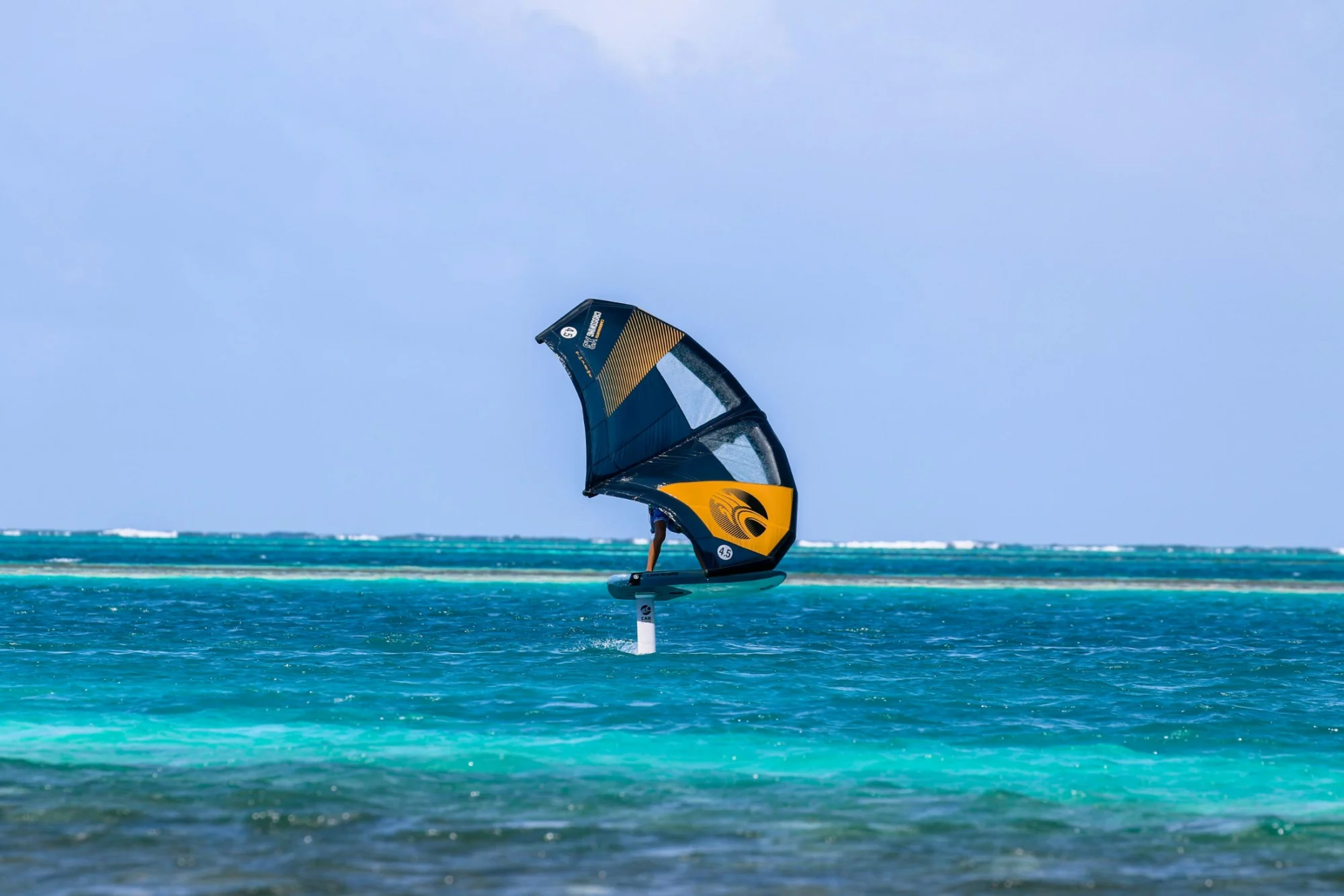
The bay is protected by an outer reef, so the wind arrives without the swell, and the trade winds build through the early afternoon almost every day. The water sits around 27°C year round, which means no wetsuit and longer sessions. It’s a 25-minute drive from Puerto Plata airport and roughly four hours from the US East Coast. We’re biased, obviously, and we’ve written the full case in our guide to why Cabarete is a top wing foil destination for beginners.
Dakhla, Morocco
The lagoon is enormous, genuinely flat, and the wind is about as dependable as it gets. It’s the spot most often named when experienced riders talk about learning conditions. The trade-off is temperature and remoteness: you’ll want a wetsuit for much of the year, and getting there takes effort.
La Ventana, Mexico
Baja’s winter wind season runs roughly November to March, which makes it the obvious North American option when everywhere else is cold. The bay gets deep quickly. Bring a shorty — the Sea of Cortez in January is pleasant, not tropical.
Prêa and Jericoacoara, Brazil
Long, steady wind season and warm water, with flat-water lagoons a short drive apart. Quality varies a lot between lagoons and some are seasonal and shallow, so this is one to book through a school that knows which one to use on any given day.
Le Morne, Mauritius
A postcard lagoon with reliable winter trades and side-shore wind. The lagoon has depth, but it also has reef — so it scores well on wind and water and less well on what happens when you fall. Worth it if the resort side of the trip matters to you.
Prasonisi, Rhodes
The Meltemi is strong and consistent through the summer, and the lagoon side is flat. The caveat is depth: parts of it are shallow enough to be a real constraint on a foil, and the wind can be more than a beginner wants in peak season.
Fuerteventura, Canary Islands
Year-round wind and a short flight from most of Europe. It’s spot-dependent rather than uniformly good — some bays are excellent for learning, others are exposed, wave-driven or shallow over rock. Go with a school rather than guessing.
Cape Hatteras, USA
Hatteras deserves its reputation, but not for the reason it’s usually given. The Pamlico Sound is recommended to beginners constantly because it’s knee to waist deep for miles — which is exactly what you don’t want on a foil.
Worth knowing: most of the Pamlico Sound is knee to waist deep for miles. That built its forty-year reputation as a place to learn to kite and windsurf, and it’s the reason it keeps getting recommended to wingfoilers — but on a foil that same shallowness means touching bottom on every crash and every waterstart. You could ride a very short mast to cope with it, at the cost of holding yourself back later. There are deeper pockets, and the schools on the island know exactly where they are. Hatteras works for wingfoiling. It just doesn’t work anywhere in the sound, which is what most guides imply.
Reading about it is one thing. Doing it is another.
Progress your surfing
Small groups, patient coaches, and boards for every level.
Explore surfing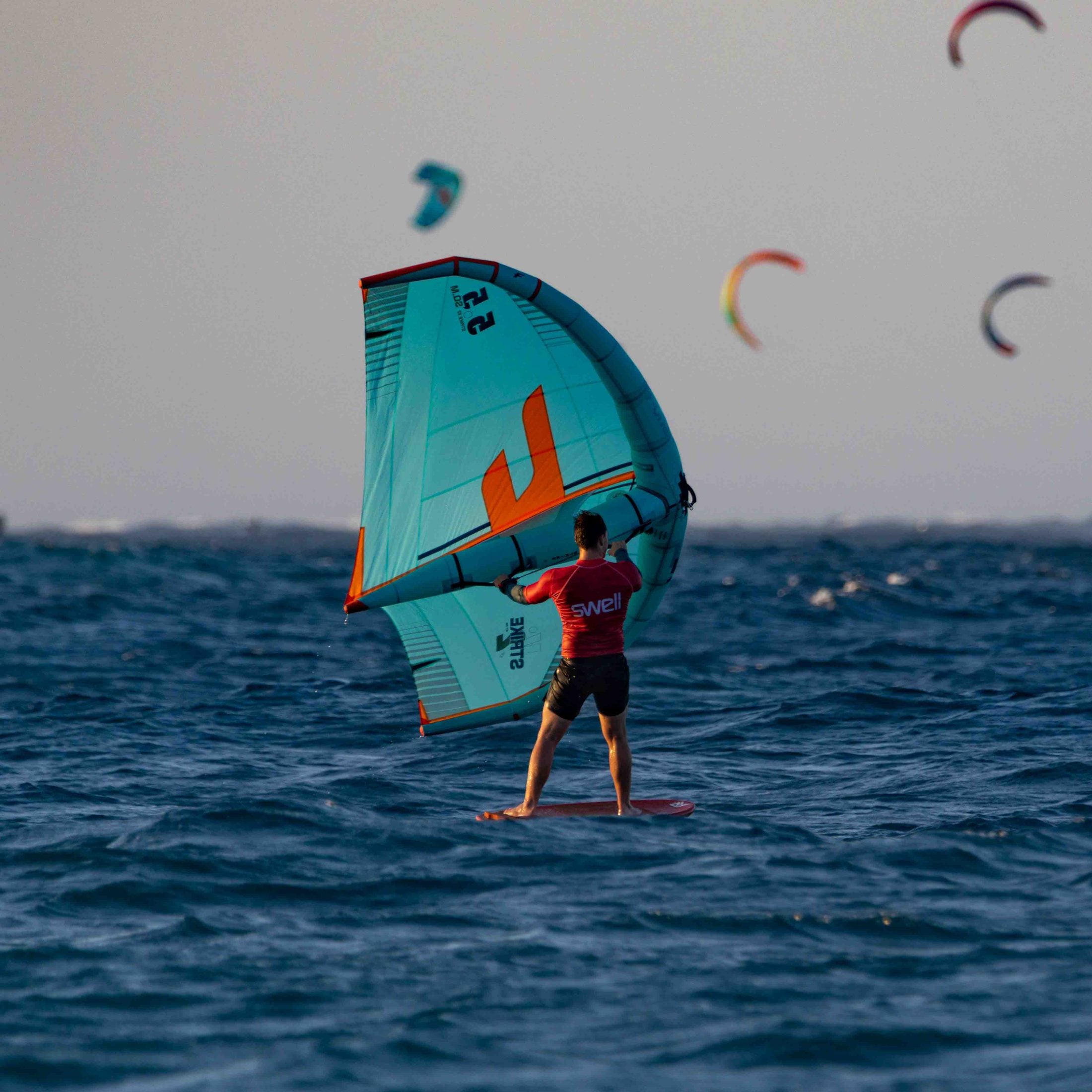
Take up wingfoiling
A new & easy to learn sport — we’ll get you flying.
Explore wingfoilingYour 'home' base
Ensuite rooms • social vibes • tasty food & large community hub.
See the retreat
When to go: wingfoil spots by season
Wind seasons matter more than school holidays. The table below shows when each destination is at its most reliable for a beginner — which is not always when it’s busiest.
| Destination | Jan | Feb | Mar | Apr | May | Jun | Jul | Aug | Sep | Oct | Nov | Dec |
|---|---|---|---|---|---|---|---|---|---|---|---|---|
| Cabarete, DR | Good | Prime | Prime | Prime | Prime | Prime | Prime | Good | Mixed | Mixed | Good | Good |
| Dakhla | Mixed | Good | Good | Prime | Prime | Prime | Prime | Prime | Good | Mixed | Mixed | Mixed |
| La Ventana | Prime | Prime | Good | Off | Off | Off | Off | Off | Off | Mixed | Prime | Prime |
| Brazil | Good | Off | Off | Off | Off | Mixed | Prime | Prime | Prime | Prime | Prime | Good |
| Le Morne | Off | Off | Mixed | Mixed | Prime | Prime | Prime | Prime | Prime | Good | Mixed | Off |
| Prasonisi | Off | Off | Off | Mixed | Good | Prime | Prime | Prime | Good | Mixed | Off | Off |
| Fuerteventura | Mixed | Mixed | Good | Good | Prime | Prime | Prime | Prime | Good | Good | Mixed | Mixed |
| Cape Hatteras | Off | Off | Mixed | Good | Prime | Good | Mixed | Mixed | Prime | Good | Mixed | Off |
Three famous spots to skip on your first trip
These are all excellent places to wingfoil. None of them is a good place to learn to wingfoil, and all three get recommended to beginners anyway.
- Tarifa: legendary wind reliability and a huge windsports scene
- Hood River: the most famous wind corridor in North America
- Shallow kite spots: decades of beginner kite lessons taught there
- Tarifa: the Levante is gusty and often far too strong for a first week
- Hood River: current, chop and cold water make progress slow and cold
- Shallow kite spots: fine with a fin, but you’ll hit bottom with a mast
That last one is the trap worth repeating, because it’s the single most common piece of bad advice in wingfoiling. A spot’s reputation as beginner-friendly was usually built by kiteboarders and windsurfers, for whom shallow water genuinely is safer. Foiling inverted that. If a guide praises a spot for being waist deep, treat it as a warning rather than a recommendation.
What’s actually included in a wingfoil holiday?
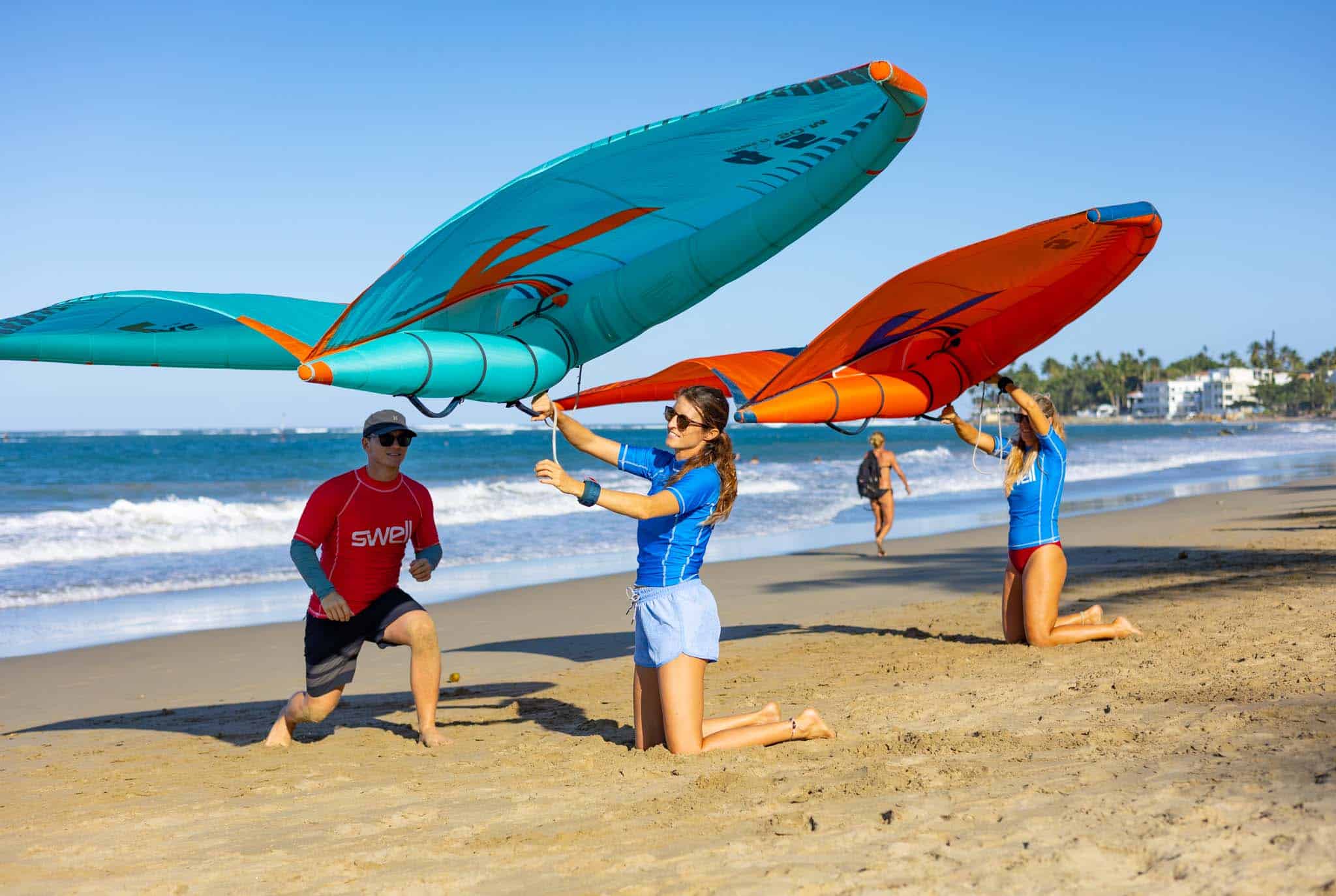
A wingfoil holiday typically bundles accommodation, gear and coaching for a week. Expect somewhere between 6 and 12 hours of instruction, all equipment provided, and lessons scheduled around the wind rather than the clock. Whether coaching is private or in a group is the single biggest variable, and the one worth asking about first.
Group lessons are cheaper and they work fine for some people. But wingfoiling has an awkward middle stage — you can handle the wing, you can’t yet control the foil — where progress depends almost entirely on getting feedback at the right moment. In a group of six, you get that feedback roughly one-sixth of the time. Our own wing foil camp in Cabarete is private for exactly this reason, with most guests flying within a week.
The other thing to check is what happens on a windless day. Good operators build in alternatives. A camp that simply cancels has effectively sold you a shorter holiday than the one you paid for.
How much does a wingfoil holiday cost?
A week-long wingfoil holiday with accommodation, gear and coaching generally runs from around €1,000 at the budget end to €3,000-plus for private tuition at a boutique camp, excluding flights. Group lessons and shared rooms sit at the bottom of that range; private coaching, single occupancy and long-haul destinations sit at the top.
Three things drive the number more than anything else. How many coaching hours are included. Whether those hours are private or shared. And whether gear is bundled or charged daily, which can quietly add several hundred euros across a week. Our own wing foil camp prices for a week are listed in full if you want a reference point to compare against.
Flights are the variable people underestimate. A cheap week in a far-flung lagoon can easily cost more door-to-door than a pricier week four hours away.
Which wingfoil spot is right for you?
I want warm water and no wetsuit
Cabarete, Brazil or Le Morne
I’m travelling from North America in winter
Cabarete or La Ventana
I’m in Europe and want a short flight
Fuerteventura or Rhodes
I want the flattest water available
Dakhla, and accept the wetsuit
I’m travelling alone
A small camp beats a big resort every time
I’m over 40 and starting from zero
Warm water, private coaching, no rush
That last one comes up more than any other question we get. It shouldn’t be a concern: our average guest is 39, and we’ve written honestly about learning to wing foil in your 40s, 50s and 60s. Fitness matters far less than most people assume. Patience and water time matter far more.
And if you’re still deciding between sports entirely, our comparison of surfing vs wing foiling for beginners covers which one gets you to a good day faster.
Choosing your first wingfoil trip
Six questions to ask any camp or school before you book. The answers tell you more than any brochure.
- How deep is the riding area at low tide?
- What’s the bottom — sand, reef or rock?
- How many coaching hours, and private or group?
- What percentage of days had rideable wind last season?
- Is gear included, or charged separately per day?
- What happens if there’s no wind for two days?
- How far is the spot from where I’m sleeping?
- How many students per instructor at my level?
Learn to wingfoil in warm water
Private coaching, steady trade winds and a bay that’s deep enough to foil in. Sixteen guests maximum, adults only, since 2009.
The part that matters most
Three things to take away. Depth over the whole riding area is the criterion almost every beginner guide gets wrong, and it’s the one most likely to ruin your week. Wind reliability beats wind strength — hours on the water are what turn into progress. And a spot’s reputation was often built by a different sport with different needs.
Get those three right and the sport itself is far more approachable than it looks. Most people are flying, at least briefly, within a week of proper coaching.
If Cabarete sounds like the right fit, Clare handles all our enquiries personally and is happy to talk through whether the timing works for your level before you commit to anything.
Frequently asked questions
Where is the best place to learn wing foiling?
The best places to learn wing foiling combine water deep enough to clear a foil, a sand bottom, side-shore wind of 12–20 knots and warm temperatures. Cabarete in the Dominican Republic, Dakhla in Morocco and La Ventana in Mexico all meet those conditions. Cabarete has the warmest water of the three and the shortest flight from North America, while Dakhla has the flattest water and the most dependable wind.
Where are the best wing foil spots in the world for beginners?
The strongest beginner wing foil spots worldwide are Cabarete, Dakhla, La Ventana, Prêa in Brazil and Le Morne in Mauritius. Prasonisi, Fuerteventura and Cape Hatteras also work, but each has a catch — wind strength in Rhodes, spot-by-spot variation in the Canaries, and shallow water across most of the Pamlico Sound. What separates the top five is depth across the whole riding area combined with reliable side-shore wind.
Is wing foiling harder than kitesurfing?
Wing foiling is generally easier to start than kitesurfing because the wing has no lines to tangle and can be released instantly, which removes most of the safety complexity. The foil is the harder part, so wing foiling has a gentler beginning and a longer middle. Most beginners find the first hour easier than kitesurfing and the third session harder.
How long does it take to learn to wing foil?
Most adult beginners get their first short flights within a week of consistent private coaching, assuming the wind cooperates. Handling the wing on a large board usually takes a session or two. Getting up on the foil and staying there takes several more. Progress depends far more on hours on the water than on age or fitness, which is why wind reliability matters so much when choosing where to go.
Do I need to surf or kitesurf before learning to wing foil?
No. Wing foiling is the gentlest route onto a foil, and plenty of people come to it with no board sports background at all. Previous windsurfing or kitesurfing experience helps you read the wind, but it is not a prerequisite and it will not decide how quickly you get flying. Water time and good coaching matter more than what you did before.
How much does a wing foil holiday cost?
A week-long wing foil holiday with accommodation, gear and coaching typically runs from around €1,000 at the budget end to €3,000 or more for private tuition at a small camp, excluding flights. The three things that move the price most are how many coaching hours are included, whether those hours are private or shared, and whether gear is bundled or charged daily.
When is the cheapest time to book a wing foil holiday?
Shoulder months at the start and end of a destination’s wind season are usually cheapest, but they are also the least reliable for wind. For a first trip, paying more for a prime-season week is normally better value than saving on a week where you might only get on the water twice in seven days.