The Caribbean has a reputation problem among people who want to learn to surf. Half the internet says it is a flat turquoise lagoon with no waves. The other half publishes lists of Soup Bowl, Rincón and Bathsheba, which are heavy reef breaks that a first-timer has no business paddling out at. Neither version helps you book a trip.
We have run a beginner surf camp on the north coast of the Dominican Republic since 2009, and before that we spent 25 years and more than 20 countries working out where a complete beginner actually has the best week. This guide scores nine Caribbean surf destinations purely on beginner-friendliness, and then does the part almost nobody does: tells you which months actually work.
Full disclosure up front. We are based in the Dominican Republic, so we are not a neutral referee. What we can promise is the reasoning behind every score, so you can disagree with us where you want to. We will also tell you plainly where another island beats ours.
This guide is written for adult beginners — people who have never stood on a board, have one or two weeks of holiday, and want to spend that week actually surfing rather than watching from the beach. If you already surf and are hunting reef barrels, the rankings below will look wrong to you, and that is deliberate.
- We have run a beginner surf camp on Playa Encuentro, Cabarete, since 2009, and have taught thousands of adult first-timers there.
- We surfed in more than 20 countries across 25 years before choosing where to build, and seriously evaluated several of the islands scored below.
- Jeroen Mutsaars, who wrote this, has 40+ years in watersports and 25+ years in the surf travel industry, and has lived on the north coast of the Dominican Republic since 2004.
- Every island here is scored on stated criteria you can disagree with, and we have declared our commercial interest wherever it touches a verdict.
Is there actually surf in the Caribbean?
Yes. The Caribbean gets real, rideable surf for most of the year, but it comes from a different engine than the Pacific. Surf forecasters including Surfline and the Stormrider Surf Guides put the region’s reliable window at roughly October or November through March. Most of it arrives as North Atlantic groundswell generated by winter storms off the eastern seaboard of North America, which is why the region’s season runs roughly November to March rather than through the summer.
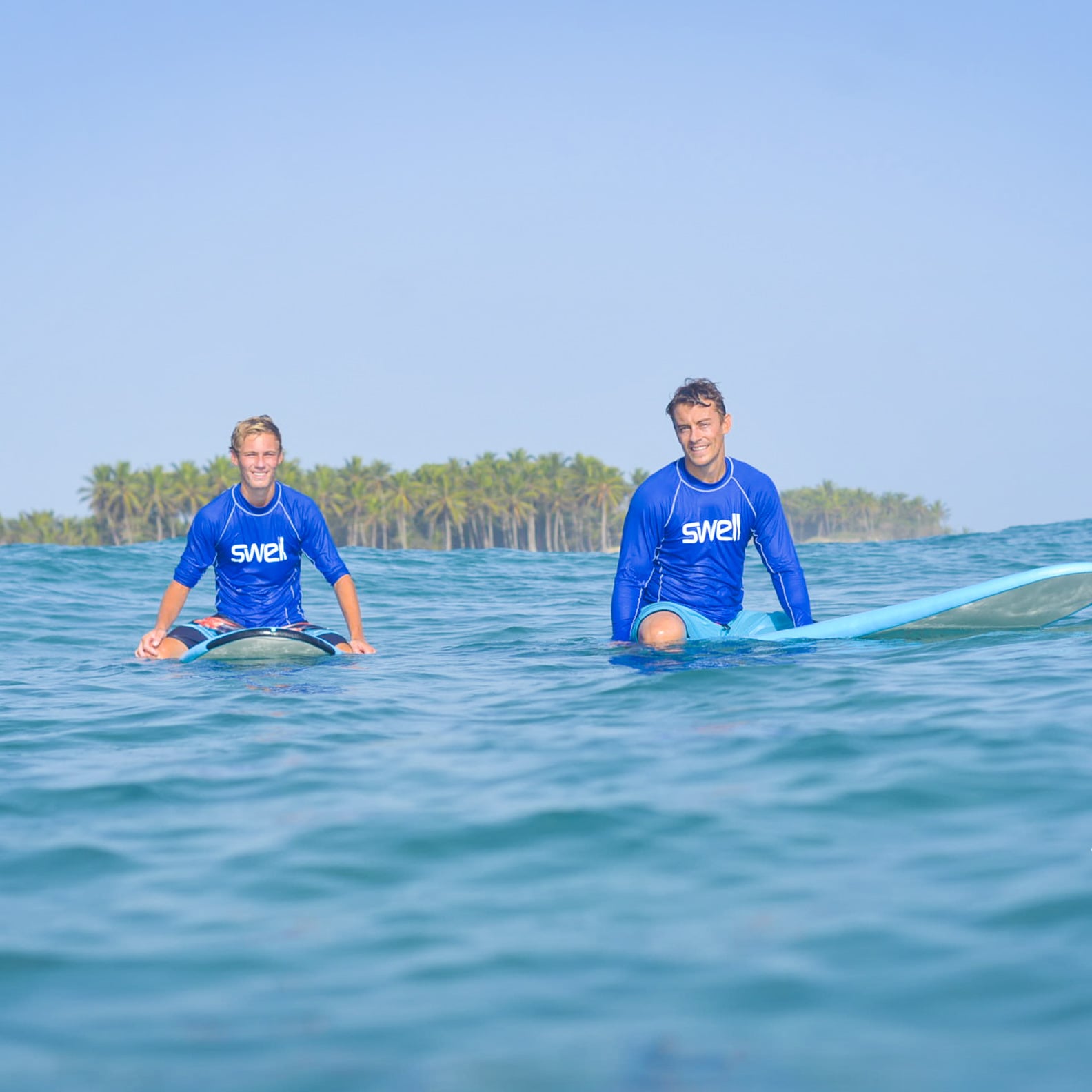
The mechanism matters, because it explains the whole shape of this guide. Cold air spilling off eastern Canada meets the warm Gulf Stream and spins up low-pressure systems. Those systems generate swell that travels thousands of miles south, arriving at the islands as clean, long-period groundswell. It hits north- and east-facing coasts hardest and leaves south- and west-facing coasts comparatively sheltered. Read that window as a season for wave size, not for learning. The two are rarely the same months, and on several islands they are opposites.
The Caribbean also gets a secondary source: the northeast trade winds, which blow near-constantly and produce shorter-period windswell on exposed windward coasts. That windswell is messier, but on some islands it is what keeps things surfable outside the winter months.
What the region does not get is a reliable summer groundswell. From roughly June to September, most Caribbean islands go small to flat, with the exception of hurricane swells, which are neither predictable nor something to plan a beginner holiday around. If you have read our guide to the best places to learn to surf, this is the single biggest difference between the Caribbean and the Pacific coast of Central America.
Why most “best Caribbean surf” lists mislead beginners
Almost every Caribbean surf article ranks islands by their best wave, not by their easiest wave. Those are two completely different rankings, and following the wrong one is how beginners end up on a trip where they never get in the water.
Look at what the lists actually name. Soup Bowl in Barbados: a thick, grinding right over shallow reef. Tres Palmas in Puerto Rico: a big-wave spot. Salsa Brava in Costa Rica: widely considered the heaviest wave in the country. Palmetto Point in Antigua: a secret spot that stayed secret because of who could ride it.
These are genuinely world-class waves, and the better guides, including Lonely Planet’s round-up of Caribbean surf, are worth reading once you can surf. None of them has any relevance to your first week on a board. Worse, an island can have a phenomenal expert wave and nothing at all for a beginner, because the two need opposite conditions. An expert wave wants deep water, then a sudden shallow reef. A beginner wants a long, gently shelving sand bottom where broken whitewater rolls in at waist depth for a hundred metres.
A useful test when you are reading any surf destination guide: if the article names the wave before it names the beach, it was written for surfers who already surf. If you are not sure where you sit, our what level of surfer am I guide will place you in about two minutes.
Where to learn to surf in the Caribbean: what makes an island work
A good beginner island gives you a sandy or forgiving inside section that stays rideable when the outside is big, warm water you can stand up in, no dangerous rips or shallow reef where you are learning, and a short transfer from the airport. Get those four right and most adults are riding waves inside a week.
These are the criteria we used to score every destination below, and they are the same ones we used when we were choosing where to build:
- A graduated break. This is the big one in the Caribbean. You want a beach where the inside whitewater still works on the days the outer peaks are firing, so a big swell does not cancel your lesson.
- Consistency. Surfable waves most weeks of the year, not a six-week window you have to gamble your annual leave on.
- Real safety margin. No strong rips at the learner spot, no shallow reef under the whitewater, and water you can stand in.
- Short, simple transfer. On a one-week trip, a four-hour road transfer at each end costs you two surf days.
- Actual infrastructure. Qualified coaches, soft-top boards in the right volume, and someone who will change the plan when the forecast changes.
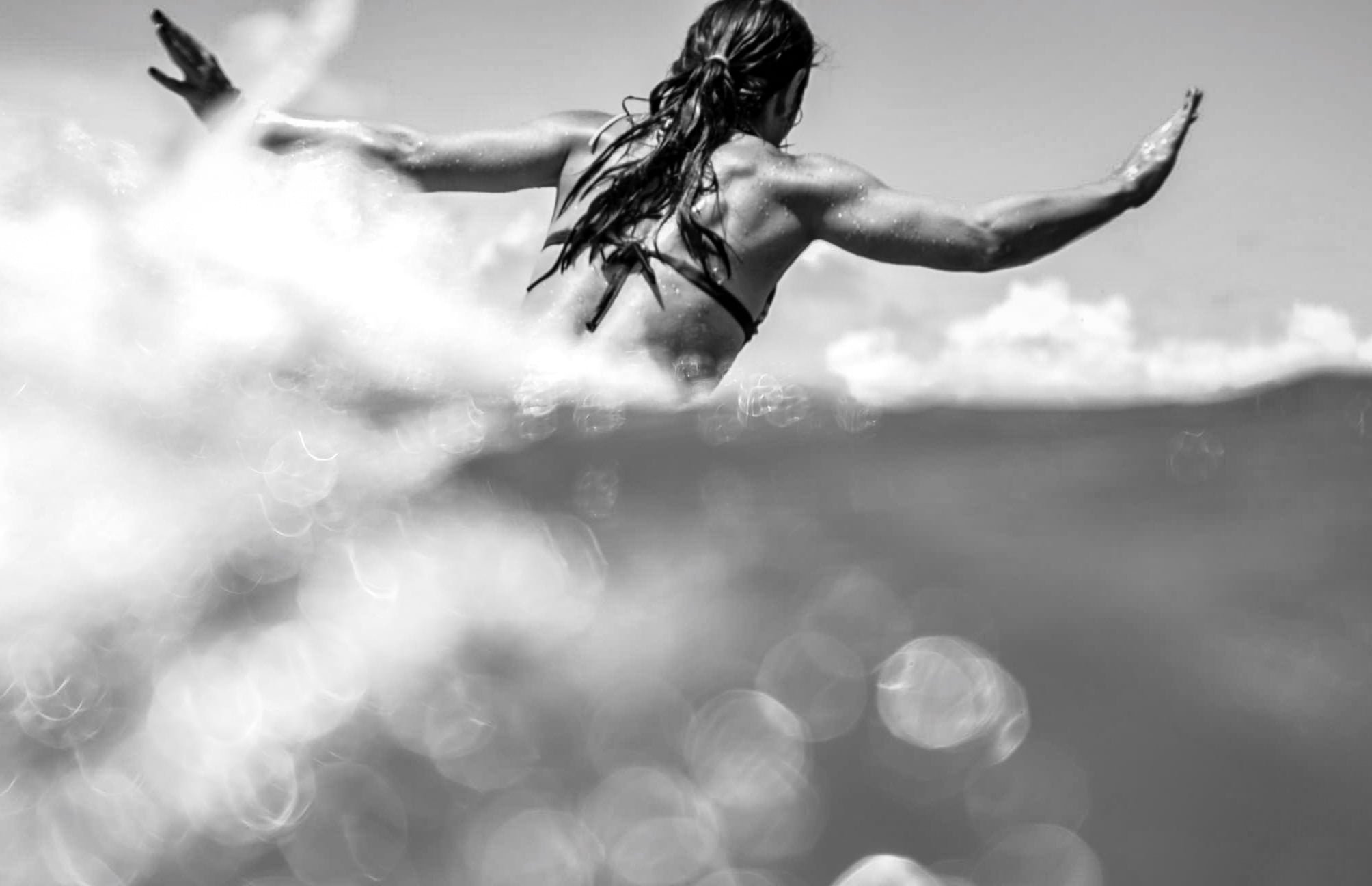
Nine Caribbean surf destinations, scored for beginners
These are scored purely on how well they suit somebody who has never stood on a board, not on scenery, nightlife or how good the best wave gets. Several islands that rank highly in general surf guides score badly here, and that is the point.
| Destination | For a first-timer | The beginner break | Water | Airport → surf | Beginner season | Cost |
|---|---|---|---|---|---|---|
| Dominican Republic (Cabarete) |
Ideal | Inside sections at Playa Encuentro | 26–28°C 79–82°F |
25 min from POP | All twelve months | Moderate |
| Barbados | Very good | Freights Bay, south coast | 26–28°C 79–82°F |
~25 min from BGI | Nov–Apr | High |
| Puerto Rico (Rincón / Aguadilla) |
Very good | Marías, Jobos inside, on small days | 26–29°C 79–84°F |
20 min from BQN 2.5 h from SJU |
Feb–May | Moderate–high |
| Jamaica (Boston Bay) |
Good | Boston Bay, on trade-wind days | 27–29°C 81–84°F |
2.5–3 h from KIN | Nov–Apr | Low–moderate |
| Guadeloupe & Martinique |
Good | Le Moule and north-coast beaches | 26–29°C 79–84°F |
30–60 min | Nov–Apr | Moderate–high |
| Bocas del Toro, Panama |
Fair | Paunch inside, Isla Carenero | 27–29°C 81–84°F |
Flight + boat from PTY | Dec–Mar | Low–moderate |
| Costa Rica Caribbean coast |
Fair | Cahuita Black Beach, Playa Negra | 27–29°C 81–84°F |
4–5 h from SJO | Dec–Mar | Moderate–high |
| Bahamas (Eleuthera) |
Fair | Surfer’s Beach, small days only | 24–28°C 75–82°F |
Car essential | Nov–Mar | High |
| Antigua, Tobago, St. Martin |
Not yet | No established learner break | 26–29°C 79–84°F |
Varies | — | High |
Scores reflect beginner suitability only. Several of these islands have far better waves than the Dominican Republic once you can actually surf. Transfer times are indicative and assume a direct road or short flight transfer.
The three islands that genuinely work for a first week
Three destinations clear the bar comfortably. Here is the honest case for and against each, including our own.
Dominican Republic — Cabarete and Playa Encuentro
This is where we chose to build, so read the following with that in mind. The reason we chose it is structural rather than sentimental: Playa Encuentro has several distinct peaks strung along one beach, from soft inside whitewater to fast reef waves, which means the swell size that ruins a beginner day on a single-break island simply moves you further inside here. It is also the most consistent beginner surf in the region, with waves on the great majority of days across the year, and it sits 25 minutes from an international airport. Worth saying plainly, because most guides get this backwards: the famous winter swell window here is the season for experienced surfers. The small, clean summer months are the easiest of all to learn in, and the shoulder months sit comfortably in between. There is no bad month to arrive as a beginner.
- Graduated peaks — a big swell moves you inside rather than cancelling the day
- The most consistent beginner surf in the Caribbean, effectively year-round
- 25 minutes from Puerto Plata airport; roughly 3h45 nonstop from New York
- 27°C water, no wetsuit, ever
- Deep bench of established surf schools and adult beginner camps
- Trade winds usually arrive early afternoon, so surfing here is a morning sport
- The outer peaks are reef, and they are genuinely not for beginners
- Cabarete is a working watersports town, not a manicured resort strip
- This is an Atlantic-facing coast, so it is not the calm turquoise postcard beach
Barbados — Freights Bay
Barbados is the most swell-exposed island in the Caribbean, sitting about 100 miles further east into the Atlantic than its neighbours. That reputation is built on Soup Bowl, which you should ignore entirely. What matters for a beginner is Freights Bay on the south coast: a long, slow, forgiving left that is one of the friendliest learner and longboard waves in the region, roughly 25 minutes from the airport.
- Freights Bay is genuinely one of the best learner waves in the Caribbean
- Short airport transfer and excellent general tourism infrastructure
- English-speaking, easy to navigate, very safe
- Good surf school scene on the south coast
- Expensive — typically the priciest option on this list once food and lodging are counted
- Beginner options are concentrated in one small stretch, which gets crowded
- Summer months go small and often unrideable for learning
- Little scope to progress locally without stepping onto serious reef
Puerto Rico — Rincón and the northwest
Puerto Rico has the best waves on this list and a genuine surf culture to match. For US travellers it is also the easiest: no passport, US dollars, US phone service and direct flights. The catch is timing. Puerto Rico’s famous season, roughly October to March, is exactly the period when the swell is frequently too big for a complete beginner, and the summer is often flat. The beginner sweet spot is the shoulder.
- No passport, no currency change and no roaming charges for US travellers
- Excellent surf schools and board hire, especially around Rincón and Aguadilla
- Huge variety of breaks, so you can keep progressing for years
- Fly into Aguadilla and you are 20 minutes from the water
- Peak season swell is often too big for a first-timer
- June to September is frequently flat, so summer trips are a gamble
- Most named spots are reef, not sand
- Rincón is 2.5 hours from the main San Juan airport
When to go, and what the month actually decides
Timing matters more in the Caribbean than in almost any other surf region, because the season that produces the region’s best waves is also the season that overwhelms most of its beginner spots. This matrix rates each destination month by month for a complete beginner, not for wave quality.
| Destination | Jan | Feb | Mar | Apr | May | Jun | Jul | Aug | Sep | Oct | Nov | Dec |
|---|---|---|---|---|---|---|---|---|---|---|---|---|
| Dominican Republic | P | P | P | P | P | P | P | P | P | P | P | P |
| Barbados | P | P | P | G | M | M | M | M | – | M | G | P |
| Puerto Rico | M | G | G | P | P | – | – | – | – | M | M | M |
| Jamaica | G | G | G | G | M | M | M | M | – | M | G | G |
| Guadeloupe / Martinique | G | G | G | G | M | – | – | – | – | – | M | G |
| Bocas del Toro | M | M | M | – | – | M | M | M | – | – | – | M |
| Costa Rica Caribbean | M | M | M | – | – | M | M | M | – | – | – | M |
| Bahamas (Eleuthera) | M | M | M | – | – | – | – | – | – | – | M | M |
Two patterns are worth pulling out of that grid, because they decide most trips.
Summer is not the problem people assume it is. June to September is when most people can actually take leave, and it is the smallest stretch of the Caribbean year almost everywhere. On most islands small means flat, which is a wasted trip at any level. In the Dominican Republic it means small and consistent, and small is exactly what you want on day one: slower waves, softer whitewater, less intimidating paddle-outs and more attempts per session. The real trade-off falls at the other end of the scale. Summer is the weaker window here for intermediates chasing bigger unbroken waves, not for first-timers.
The hurricane overlap. The Atlantic hurricane season officially runs from 1 June to 30 November, and NOAA puts the statistical peak on 10 September, with most activity falling between mid-August and mid-October. Direct hits on any one island are rare, but September and October carry the highest chance of a disrupted trip, and travel insurance is worth reading properly for those months.
That solid row for the Dominican Republic will look like bias, so here is the mechanism rather than the claim. Playa Encuentro is a string of peaks, and the inside section sits behind the outer ones. On a single-break island a 2-metre swell means no lesson. On a graduated beach it means the lesson moves 50 metres inshore and carries on. Judge the reasoning, not the colour of the row.
The Dominican Republic by level, not by month
What actually changes month to month here is which level of surfer gets the best week, not whether a beginner can surf. This is the honest breakdown.
| Season | Typical conditions | Complete beginner | Improver / intermediate | Advanced |
|---|---|---|---|---|
| Jun–Sep (summer) |
Small, clean, consistent; light mornings, trades by early afternoon | Best of the year | Fine, on the smaller side | Quiet |
| Oct–Nov & Apr–May (shoulder) |
Mixed; the first and last north swells of the season | Excellent | Excellent | Good |
| Dec–Mar (winter) |
North Atlantic groundswell; outer peaks from head-high upwards | Still fine, on the inside | Best of the year | Best of the year |
The beginner column barely moves across the year, which is the whole point of a graduated beach. The intermediate and advanced columns are where the season actually matters.
Which Caribbean island is right for you?
The best island depends on when you can travel, where you are flying from and whether you want to keep surfing after this trip. Here is the short version.
What a beginner week in the Caribbean actually looks like
Most adults who commit to daily coaching in warm, gentle waves go from never having stood on a board to catching unbroken waves within a week. The pattern is remarkably consistent, and it has more to do with hours in the water than athletic ability.
Indicative progression for an adult beginner with daily coaching in gentle, warm-water conditions. Individual progress varies with fitness, confidence in the water and how consistent the surf is that week.
Two practical notes that apply anywhere in the region. First, surf early. The northeast trade winds usually build through the day across most of the Caribbean, so the cleanest conditions are almost always in the morning. Second, do not book a trip around one famous wave. Book around a beach that has something rideable across a range of swell sizes, because you cannot control what shows up in your week.
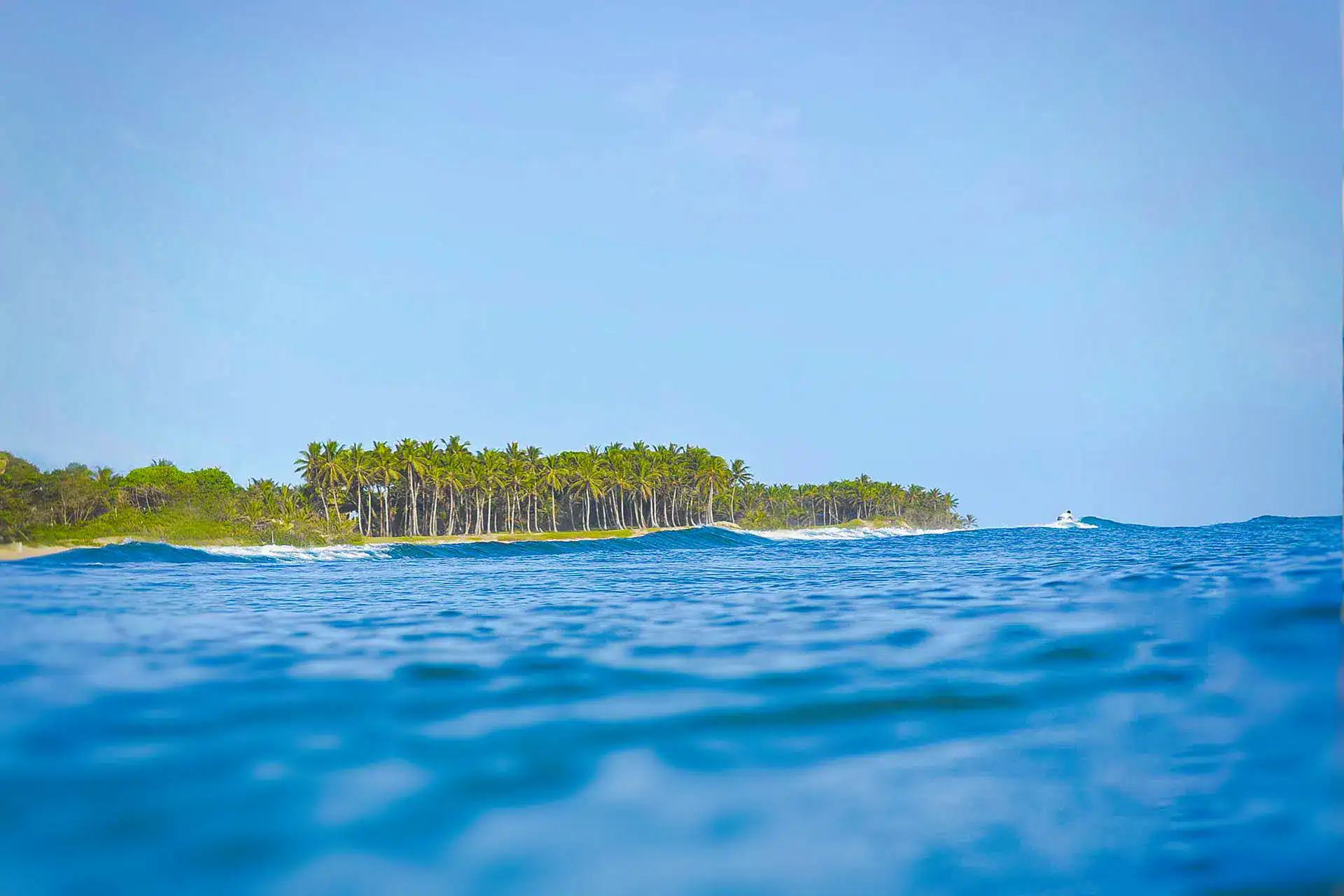
If you want to learn with us
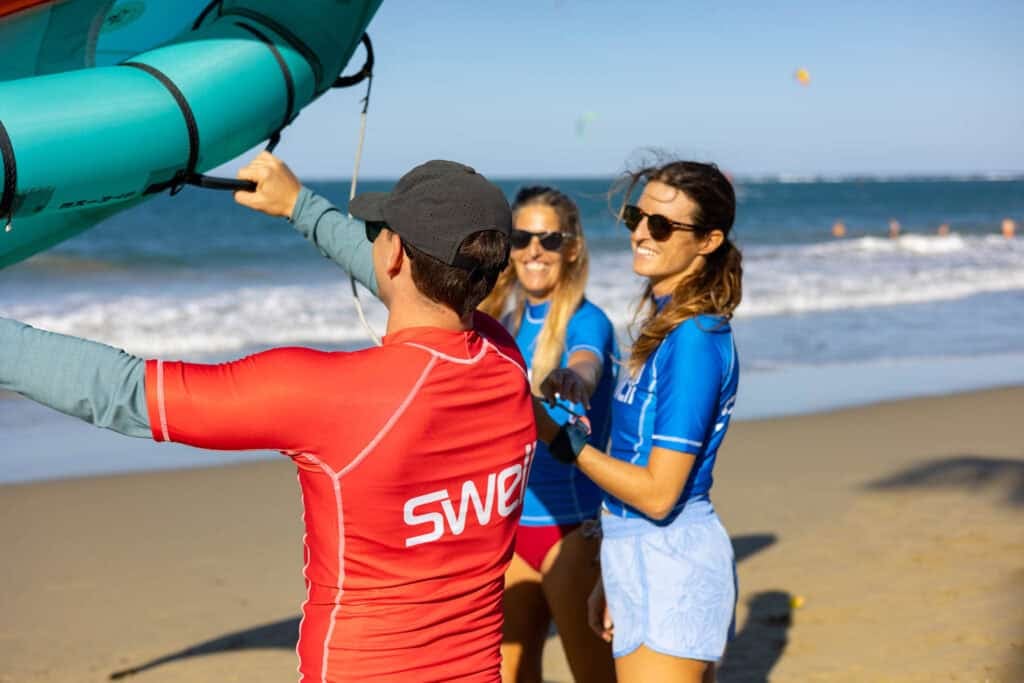
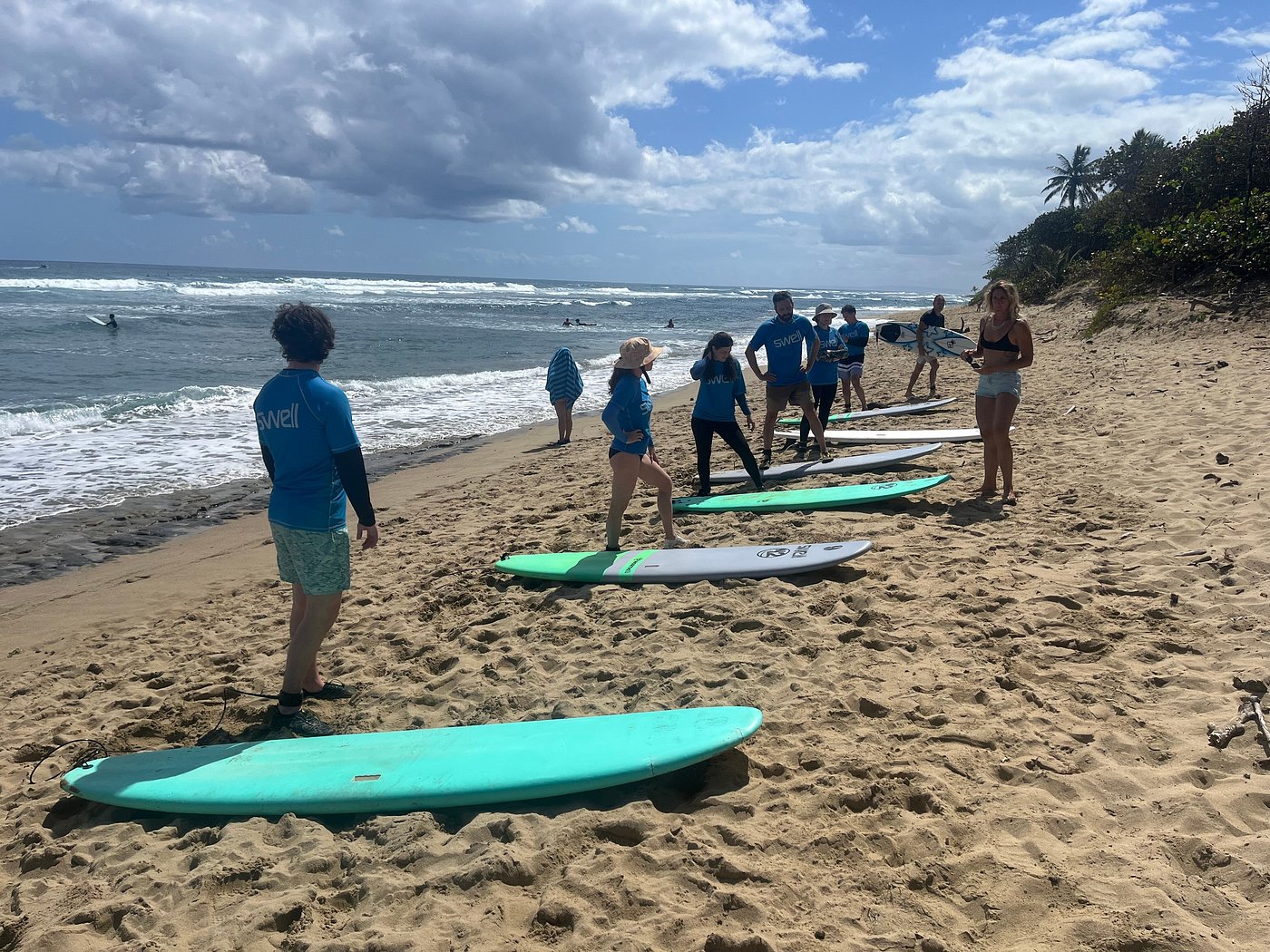
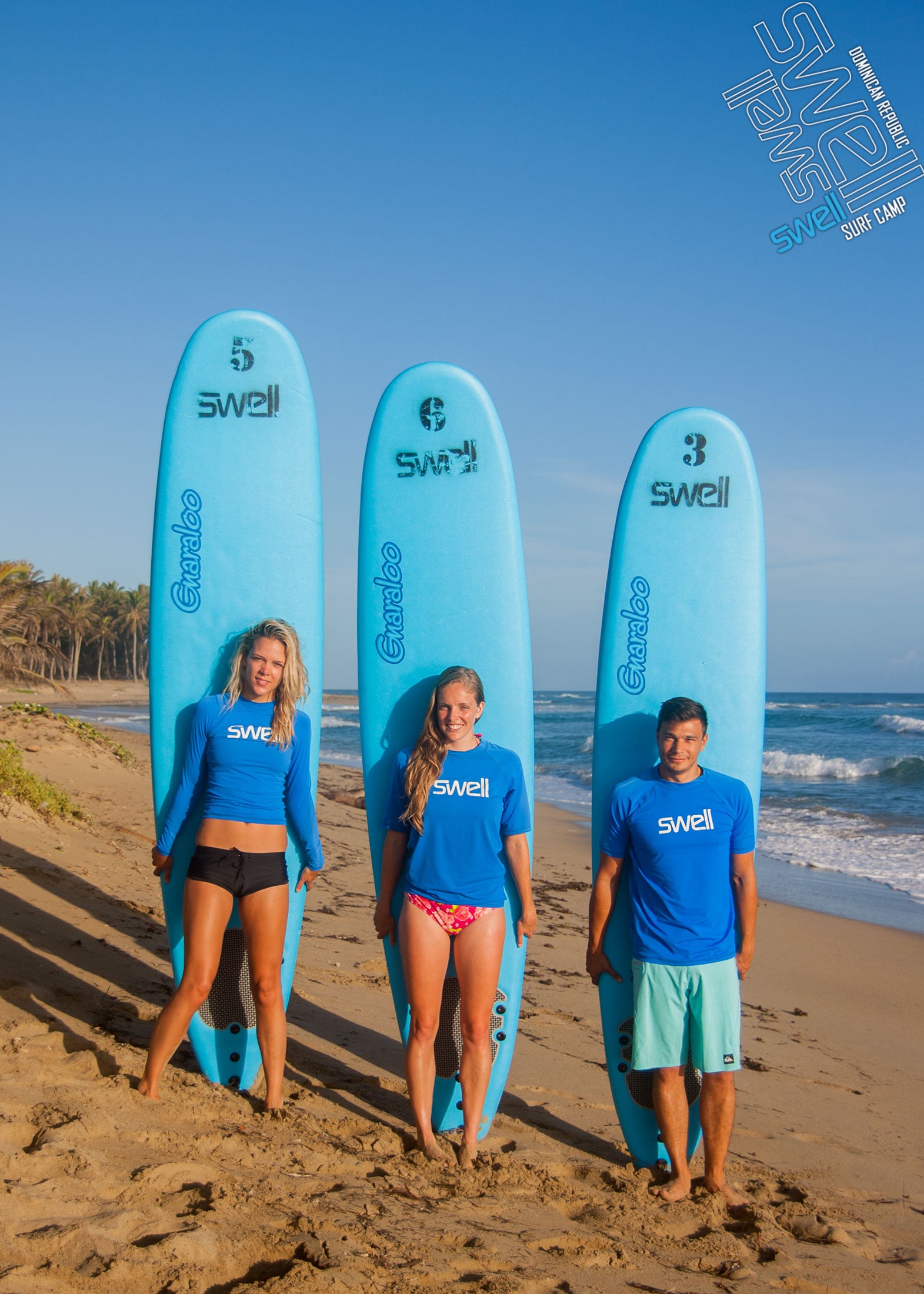
We built Swell specifically for adult beginners rather than for surfers who already surf. Our average guest is 39, most have never stood on a board, and lessons run in small groups matched by ability rather than age, a short walk from Playa Encuentro. You can see how the coaching is structured on our surfing page.
If you are weighing the Caribbean against the Pacific side of Central America, our Dominican Republic vs Costa Rica comparison goes through that decision in detail, bias declared.
The six-point check before you book any Caribbean surf trip
- Ask which beach, not which wave. If the answer is a named reef break, it is not a beginner beach.
- Ask what happens on a big day. A good operator describes where they move you. A bad one says “we cancel”.
- Check the month against your level. On most islands the month decides whether you surf at all. On a graduated beach it only decides who gets the best week.
- Confirm the transfer time. Anything over two hours each way costs you roughly one surf day per week.
- Ask about group size and boards. Small groups matched by ability, and soft-tops with enough volume for your weight.
- Read the insurance wording if you travel August to October. That is the most active stretch of the Atlantic hurricane season.
Reading about it is the easy part
Tell us your dates and who is coming, and we will send a custom price and availability quote, almost instantly.
So: you can absolutely learn to surf in the Caribbean, as long as you pick for the inside section rather than the headline wave, and check the month before you book the flight. Pick the island that suits the surfer you are this year, not the one you hope to be in five. Warm water, a forgiving inside section and a patient coach will take you further in seven days than any bucket-list break. If you are torn between two of these islands, send us a message; there is a good chance we have surfed both and can tell you honestly which one fits your week.
Frequently asked questions
The questions we are asked most often by people weighing a first Caribbean surf trip.
Where is the best place to learn to surf in the Caribbean?
For a complete beginner we would point to the Dominican Republic, specifically Playa Encuentro in Cabarete, though we run a camp there so weigh that accordingly. It has a graduated beach where the inside section stays rideable when the outer peaks are big, consistent waves effectively year-round, 27°C (81°F) water and a 25-minute airport transfer. Barbados (Freights Bay) and Puerto Rico are the strongest alternatives.
What is the best time of year to surf in the Caribbean?
That depends entirely on your level. The region’s main swell season runs roughly November to March, driven by North Atlantic storms, and that is the window for experienced surfers. For complete beginners the smaller shoulder and summer months are usually better, because the waves are slower and softer. On most islands small means flat and the trip is wasted; the Dominican Republic is the exception, where small still means consistent and rideable.
When is the best time to learn to surf in the Dominican Republic?
Any month. The summer, roughly June to September, has the smallest and cleanest waves, which makes it arguably the easiest time of all to start. The winter months from December to March bring the big North Atlantic swells that experienced surfers travel for, but the beginner section at Playa Encuentro sits inside the outer peaks and stays safe and rideable through them. The season changes which level of surfer has the best week, not whether a first-timer can surf.
Is the Caribbean good for beginners, or are the waves too big?
Both, depending on the island. The waves themselves are not the problem; the lack of a safe inside section on most islands is. Many Caribbean breaks are reef with deep water right up to the takeoff, which offers a beginner nowhere gentle to practise. Choose a beach with a sandy, shallow inside and the region is excellent for learning.
Can I surf in the Caribbean in summer?
Yes, and if you are a complete beginner it is a good time to come. June to September is the smallest stretch of the Caribbean year, because the North Atlantic swell engine is dormant. On most islands that tips into flat and the trip is wasted. In the Dominican Republic it stays small but consistent, which is the gentlest condition there is to learn in. It is the weaker window for intermediates and experts, and it overlaps with hurricane season, whose most active stretch runs from mid-August to mid-October.
Do I need a wetsuit to surf in the Caribbean?
No. Water temperatures across the region sit between roughly 26 and 29°C (79 to 84°F) year-round, so boardshorts or a swimsuit are enough. Most people wear a rashguard or a long-sleeved top, less for warmth than to avoid sunburn and board rash across several hours of paddling a day.
How many days does it take to learn to surf in the Caribbean?
Most adults who take daily coaching in warm, gentle waves are standing on broken waves within two to three days and attempting unbroken waves by the end of a week. Warm water is the hidden accelerator: with no wetsuit and no cold, you can stay in for two or three hours a session, which is where the repetitions come from.