Almost everyone researching a first surf trip starts in the same place: a list of the best waves in the world. It feels like the sensible move. It is also the single fastest way to end up somewhere that is not good for beginner surfers, on a wave you will spend the week watching from the sand.
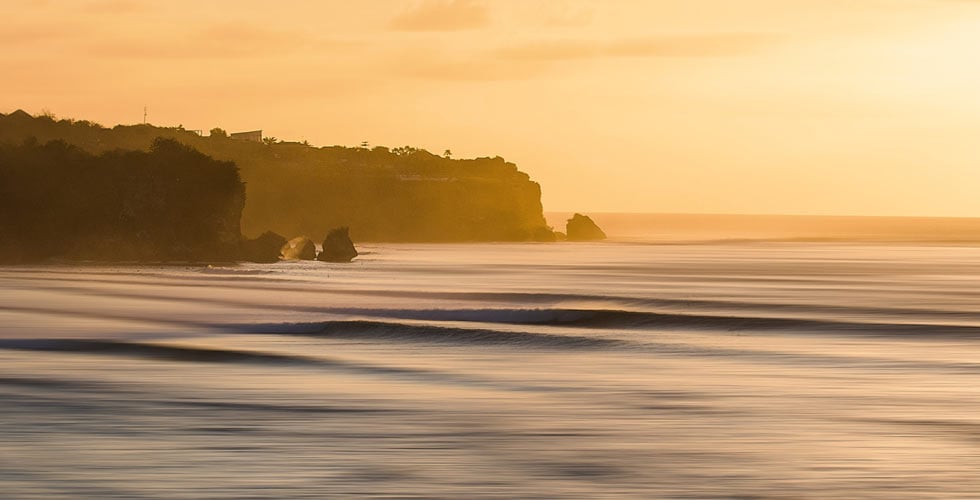
We know, because we made a version of this mistake ourselves with real money. In 2020 we opened a surf retreat in the Bingin and Uluwatu area of Bali, one of the most celebrated stretches of coastline on earth. Covid closed it. When the world reopened and we went back to look at starting again, we decided not to.
What follows is not a takedown of Bali, a place we loved enough to build in. It is the honest reasoning of two people who have now run a beginner operation next to a world-famous wave and next to a quiet one, and found out the hard way how differently those two weeks go.
We built a surf retreat in Bali, then chose not to reopen it
In 2019 Bali looked like the obvious place to build. The waves are extraordinary, the island is set up for visitors, and the Bukit peninsula in particular has a density of quality surf that almost nowhere else can match. We committed, and in 2020 we opened.
Then Covid shut the island, and shut us with it. That part was not a decision, it was simply what happened to everyone in travel that year. It was a genuinely sad thing to walk away from something we had just finished building.

The decision came later. When borders reopened, a very large number of people who had spent two years indoors decided that Bali was where they wanted to be, either on holiday or as a remote worker with nowhere in particular to be. Foreign arrivals have since passed the pre-pandemic peak, with almost 6.95 million direct foreign arrivals recorded in 2025. You do not need the statistics to feel it. You need about ten minutes in the water.
On a normal morning at Bingin we were looking at 60 to 100 people sitting on a single peak. Not on the beach, on the peak. Somewhere in the region of six to eight surf schools would be working the same stretch of water at the same time, and there were more than forty operating across the Bukit as a whole. Every one of them with a group of beginners on foam boards, in a lineup of experienced surfers who had travelled a long way for those waves.
We sat with it for a while, because we badly wanted the answer to be yes. But we could not look at that water and honestly tell a nervous 45-year-old from Boston that we would give them a safe, unhurried, enjoyable week in it. So we did not reopen.
What “world class” actually means for beginner surfers
World class is a rating written by expert surfers for expert surfers. It rewards power, hollowness, shallow reef and consistency. Those qualities are not merely different from what a beginner needs, they are the opposite of it, which is why the most famous waves are rarely good for beginner surfers.
Think about what makes a wave legendary. It stands up steeply and breaks with force. It runs along a reef that sits close to the surface, because that is what gives the wave its shape. It works often enough that people plan trips around it.
Now read that list again as somebody who cannot yet paddle into a wave unassisted. Steep and powerful means you get pitched rather than pushed. Shallow reef means the floor is sharp and the consequence of a fall goes up. Reliable means everybody knows about it.
That last one is the multiplier. Fame does not change the wave, it changes the number of people on it, and crowding is the factor that makes every other problem worse. A shallow reef with six people on it is a manageable risk. The same reef with sixty is a different sport.
Five things that make a famous wave hostile to a beginner
Five things decide whether a surf spot suits a first-timer: what the sea floor is made of, how deep the water is where the wave breaks, how many people are on it, what one mistake costs you, and how long it takes to get there. Famous waves tend to score badly on all five.
1. The bottom
Sand forgives. Reef and rock do not. Almost every celebrated wave in the world breaks over something hard, because that is what holds the shape that makes it celebrated.
As a beginner you will fall constantly, and you should, because that is the process. The question is only what you land on. On sand, falling is a non-event. On live coral, it is cuts, urchin spines and a real reluctance to try the next one, which is the thing that actually slows your learning.
2. The takeoff depth
Famous waves usually break in deep water off a reef edge. That means you cannot stand up, you cannot rest, and you cannot reset between attempts. You are treading water for the whole session with a board attached to your leg.
A beginner learning in chest-deep water gets something that sounds trivial and is not: the ability to stop. Stand up, breathe, get your board pointed the right way, and go again. That single difference is worth more attempts per hour than any amount of coaching.
3. The crowd
A lineup has a pecking order, and it is invisible until you break it. Who has priority, where you may sit, when you may go. Experienced surfers read it without thinking. A first-timer cannot read it at all, and the penalty for getting it wrong ranges from a hostile look to a genuinely dangerous collision.
Crowds also cost you waves, and waves are the whole point. Surfing is a timing problem, and timing is only solved by doing the thing again: paddle, feel the lift, commit, stand. Every surfer sitting between you and the peak is one repetition you do not get that week, and a beginner needs a lot of them.
If you are unsure where you currently sit, our guide to what level of surfer you are is an honest place to start.
4. The consequence
Consequence is what a single mistake costs. On a mellow beach break, the cost of a bad wave is a mouthful of seawater. On a heavy reef, it can be a trip to a clinic.
This matters beyond safety, because it quietly changes how you surf. People in high-consequence water hesitate, hold back and take fewer waves. A week spent being careful is a week spent not improving.
5. The commute
Nobody puts transfer time on a list of beginner criteria, and for our guests it was close to decisive.
The Bukit has no beginner beach. So on high tide we would take people to Bingin, and otherwise to Balangan, which sits two kilometres away as the crow flies. In the traffic that arrived after 2022, that two kilometres could take an hour each way. The Bali Sun has reported the same thing across the south of the island, where ten-minute journeys routinely stretch beyond forty-five minutes.
Do the arithmetic on a one-week trip. Two hours a day in a van is fourteen hours of a seven-day holiday, spent sitting still, looking at scooters. That is roughly a fifth of your waking week gone to a road, and it is the part of the brochure nobody photographs.
So is Bali good for beginner surfers?
Bali is not good for beginner surfers at the breaks it is famous for, which are shallow reef with deep takeoffs and heavy crowds. It does have separate beginner beaches that work well, but they are not the waves the island is known for, and reaching them costs time you do not have on a one-week trip.
We can speak about the Bukit with some authority, because we ran an operation there and made a commercial decision based on what we saw. Uluwatu and Bingin are shallow live reef with a deep-water takeoff and, on the mornings we were counting, 60 to 100 surfers on a single peak. There is no version of that water in which a first-timer has a good, safe week.
We are not going to hand out scores for places we have only surfed as visitors rather than taught in. What we will say is that the pattern is not unique to Bali. The reason a wave becomes famous is usually the same reason it punishes beginners, and the fame then adds the crowd on top. If a break is on a list of the best waves in the world, assume it is on that list for reasons that have nothing to do with you yet, and check the five factors above before you book anything near it.
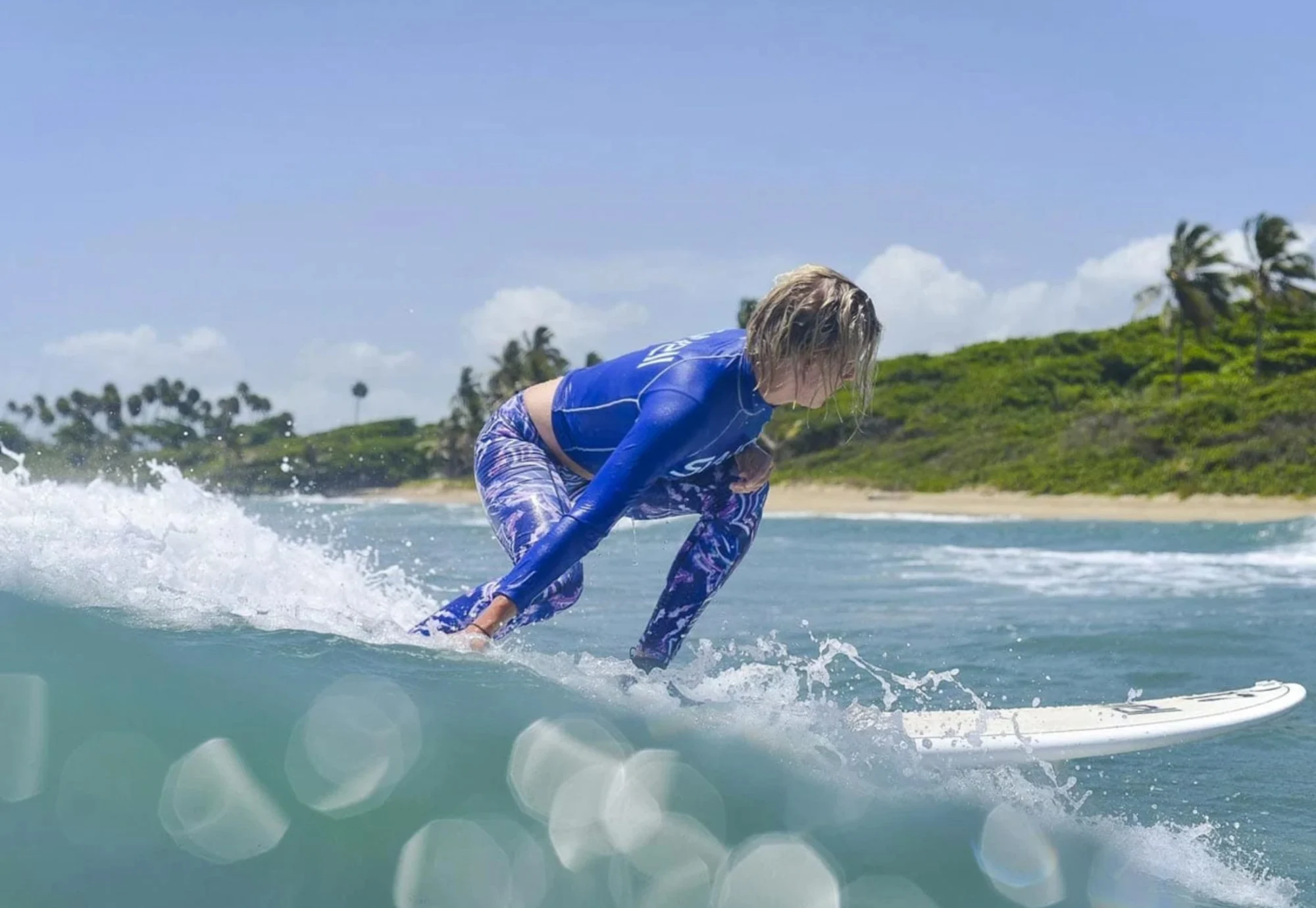
A word on our own bias. We teach at Playa Encuentro, so we are the last people you should take a neutral verdict on it from. What sits under it is flat limestone, mostly covered in sand, rather than the sharp live coral the word reef usually brings to mind. The outer peaks break in deep water and on the right swell they are world class in their own right. That is rather the point. The beginner section and the serious section are separate parts of the same beach, and neither is fighting the other for space. We think it is the right place to learn to surf, and you should weigh that against who is telling you so.
Now the honest counterweight, because plenty of people do learn to surf in Bali and it would be silly to pretend otherwise. They do it at beginner beaches like Balangan and Kuta, in the right season, with good schools. It works.
But notice what has happened. You have flown to the other side of the world for Uluwatu, and you are spending your week at a different beach entirely, having sat in a van to get there. Which raises the question the trip should have started with: why travel for a wave you will not surf?

What actually makes a surf spot good for beginner surfers
A spot is good for beginner surfers when the floor you fall onto is soft or flat, the water is shallow enough to stand in, few enough people that you get regular waves, low consequence for mistakes, and a short journey from your bed to the sea.
Flip the five factors and you have your checklist. Use it on whatever destination you are currently considering, including ours.
If you would like the same criteria applied to a longer list of countries, with water temperatures, costs and seasons, we have scored them in our guide to the best beginner surf destinations. And if Costa Rica is on your shortlist, we compare it with the Dominican Republic in detail in Dominican Republic vs Costa Rica.
Why we chose Cabarete
Before we built anything, we spent years and more than twenty countries looking for a place that scored well on all five of those factors at once. Plenty of places managed three. Very few managed five.
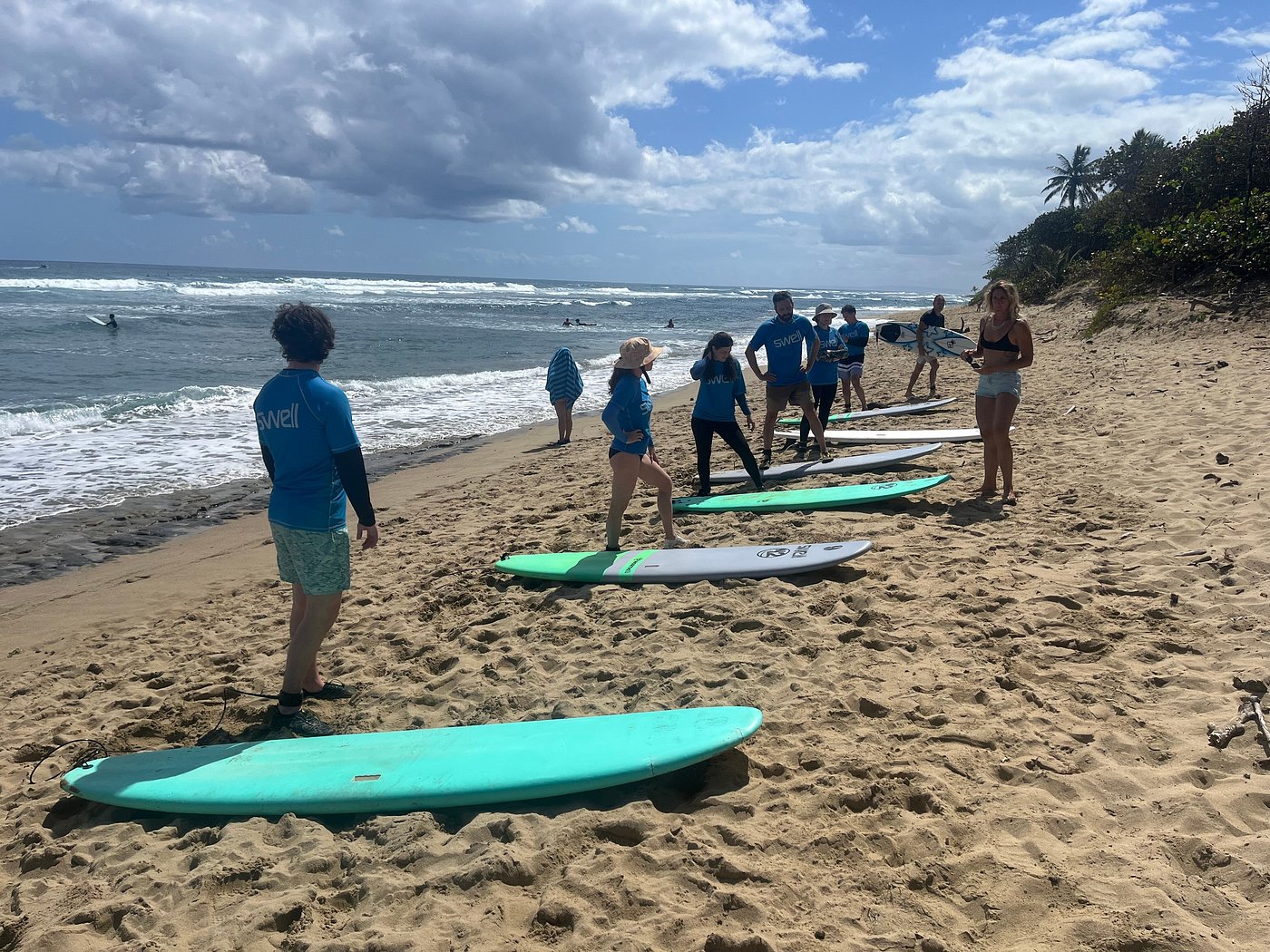
Playa Encuentro on the north coast of the Dominican Republic did. The inside section is roughly chest deep, so you can stand up and reset, and the floor is flat limestone under sand rather than the sharp coral you fall onto almost everywhere else that has waves this reliable. There are no dangerous rips or currents and nothing in the water that bites. It works nearly every day of the year, and the beach is ten minutes from our door rather than an hour.
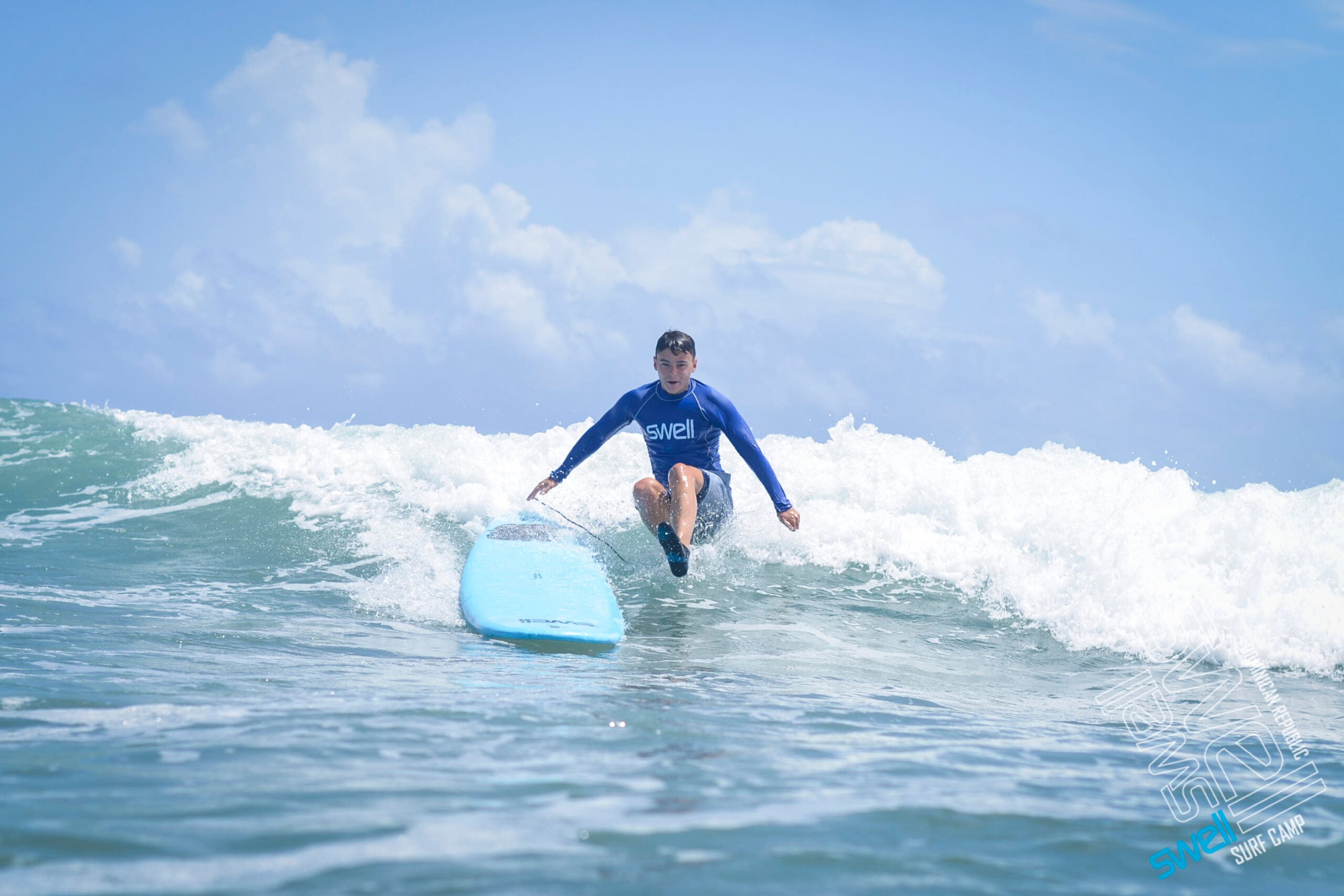
What we did not fully understand until Bali is how much the last two of those matter. We had assumed wave quality was the thing to optimise for. Running an operation next to genuinely world-class surf taught us that for a beginner on one week of annual leave, access and repetition beat wave quality every time.
- Chest-deep inside section over flat limestone and sand
- No dangerous rips, currents or marine life
- Surfable waves almost every day of the year
- Warm water year-round, no wetsuit
- Ten minutes from bed to beach
- 25 minutes from Puerto Plata airport
- A famous name. Nobody at dinner is impressed by Cabarete.
- Waves of the same size all year. It works nearly every day, but the biggest and cleanest swells run November to April.
- A manicured resort strip. Cabarete is a working town, not a compound.
You can see how the coaching works and who it is designed for on our surfing page.
The shortlist, rewritten
Three things worth taking away. World class is a rating for expert surfers, and reading it as a quality score for your first trip will send you to the wrong beach. The five factors that actually decide your week are the sea floor, the depth, the crowd, the consequence and the commute. And repetition, not wave quality, is what turns a first-timer into a surfer.
Pick the place that suits the surfer you are this year, not the one you hope to be in five. The famous wave will still be there when you are ready for it, and you will enjoy it far more having learned somewhere kinder.
Reading about it is the easy part
Tell us your dates and who is coming, and we will send you a custom price and availability quote, almost instantly.
Still weighing up destinations? Run your shortlist through our beginner surf destinations guide, and if you want an honest opinion on somewhere that is not us, just ask. Chances are we have surfed it, taught in it, or seriously considered building there.
Frequently asked questions
Is Bali good for beginner surfers?
Bali’s famous breaks on the Bukit peninsula are not good for beginner surfers. They break over shallow live reef, the takeoff is in deep water where you cannot stand, and on a normal morning we counted 60 to 100 surfers on a single peak at Bingin. Bali does have separate beginner beaches such as Balangan and Kuta that work well, but they are not the waves the island is famous for, and traffic on the Bukit can turn a two-kilometre trip into an hour each way.
Can a complete beginner surf in Hawaii?
Not at the breaks Hawaii is known for. The North Shore in winter is powerful, shallow and heavily crowded, and it is genuinely dangerous for an inexperienced surfer. Beginners in Hawaii learn on the gentle south-shore rollers around Waikiki instead, which are a lovely first wave, though the lineups are busy and the trip is expensive compared with most beginner destinations.
Is Costa Rica good for first-time surfers?
Costa Rica is a reasonable choice on wave type, because much of the Pacific coast is sand-bottomed beach break rather than reef. The weaknesses are access and crowds: the best beginner areas are often four to eight hours by road from the airport, some river-mouth spots have strong rips, and popular breaks have become busy. We compare it directly with the Dominican Republic in our destination guide.
What kind of wave is best for learning to surf?
A slow, crumbling wave breaking over sand in waist to chest-deep water, with few enough people around that you get a wave every few minutes. It should feel unremarkable. Waves that look impressive in photographs are steep, hollow and shallow, which are exactly the qualities that stop a beginner getting to their feet.
Do I need to travel to a famous surf spot to learn to surf?
No, and it usually works against you. Fame drives crowds, and crowds cut the number of waves you actually get, which is the single biggest factor in how much you improve in a week. A quiet, gentle beach where you are catching waves steadily will teach you more in seven days than a celebrated reef where you spend the session waiting your turn. Choose for repetition and access, and save the famous break for when you can use it.