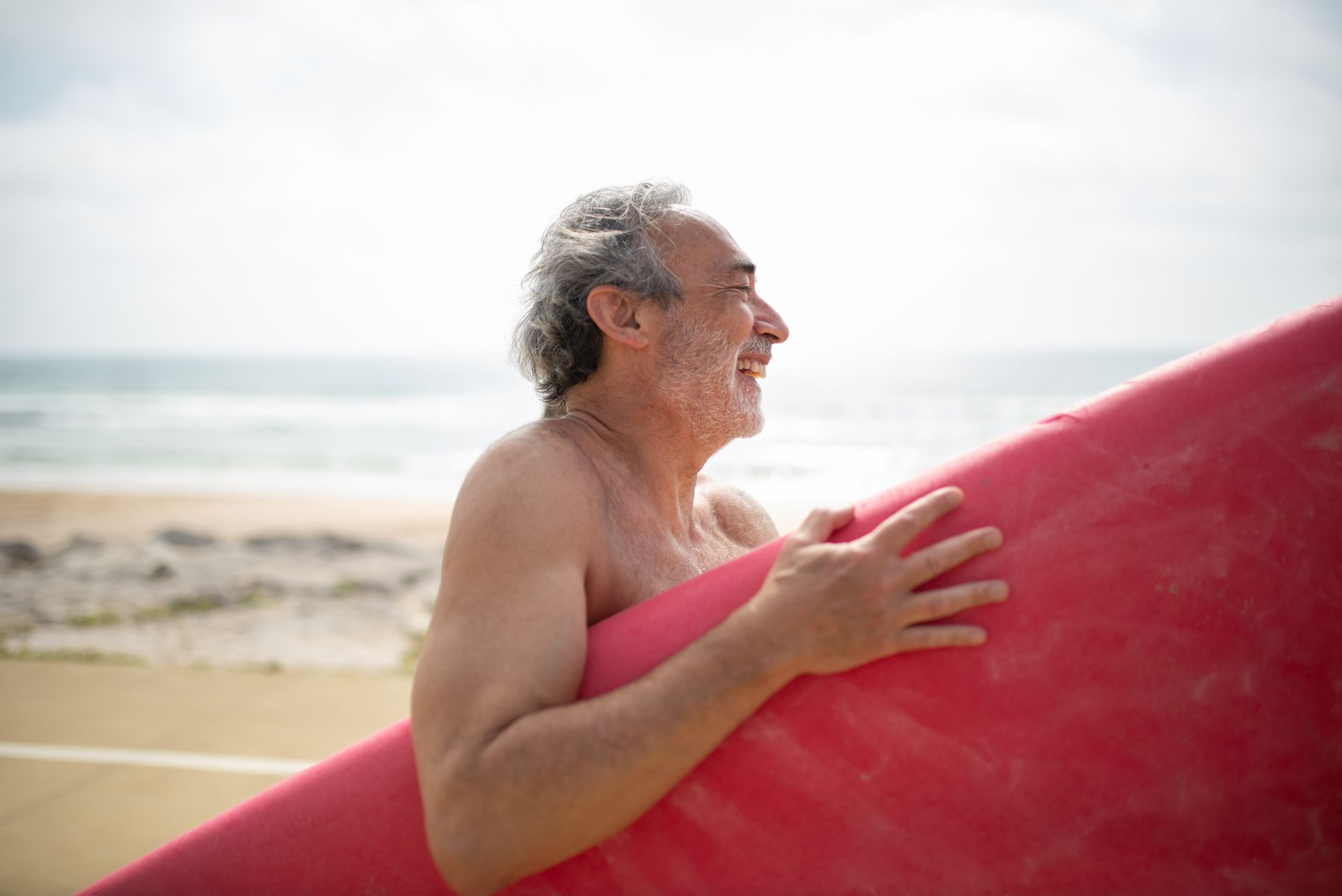
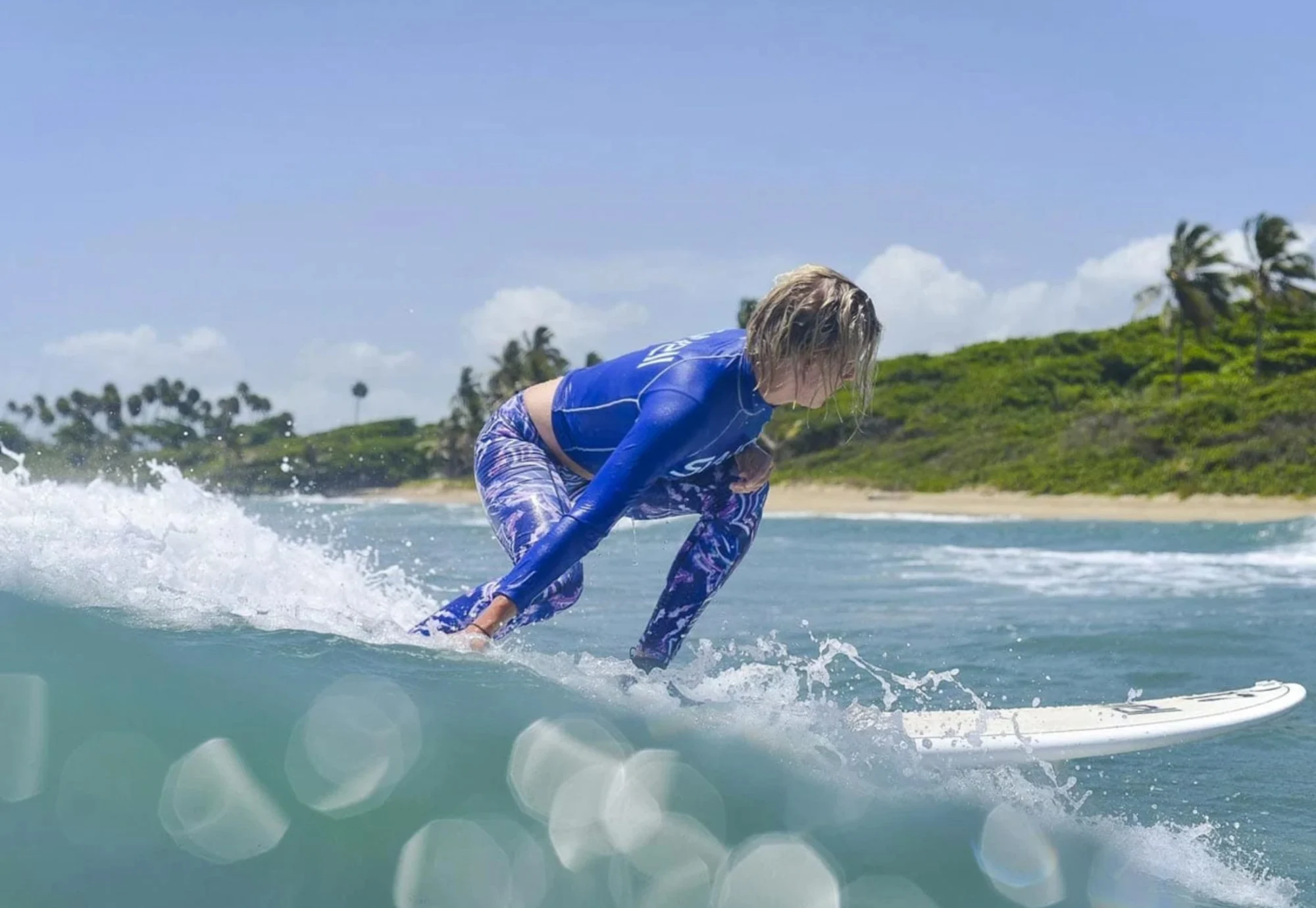
No, 40 is not too late. Nor is 50 or 60. Around 95% of the adult first-timers we coach stand up in their opening session, and our average guest is 39. What changes with each decade is not whether you can learn, but how fast you recover, how much the board matters, and how patient you are with yourself. The last of those is an advantage.
Our oldest guest so far was 78.
I mention that first because it is the question underneath every email we get from someone in their 40s, 50s or 60s, even when they do not ask it directly. They want to know whether they have left it too late, and whether they will be the oldest person on the beach looking foolish.
The answer, after coaching adults here since 2009, is no on both counts. People arrive convinced the water belongs to somebody younger, and then spend the week finding out otherwise. The specifics change every time. The pattern does not.
39Average guest age
~95%Stand up in session one
6,000+Guests taught since 2009
16Guests at a time, maximum
Is 40, 50 or 60 too old to learn to surf?
No. If you can swim well enough to look after yourself in chest-deep water and you are in ordinary health, you can learn to surf at 40, 50 or 60. Surfing rewards patience, timing and board choice far more than youth or athleticism. Our oldest guest so far was 78.
The myth is that surfing is a strength sport. It is not. It is a timing sport with a paddling tax attached. I have watched triathletes flounder for three days because they insisted on muscling the board, while somebody who had not exercised properly since university stood up before lunch on day one and kept standing.
Surfing is also non-contact and low-impact, which matters more the older you get. Nobody tackles you. Your knees take nothing. You fall into water from roughly waist height, off a soft board, in a spot our coaches picked because it is forgiving.
The genuine requirement is swimming. Not speed, not distance. You need to be able to fall over, come up, and stay calm about it. If that describes you, the rest is teachable.
What actually changes at 40, 50 and 60
Almost every article on this subject says “40, 50 or 60, age is just a number” and then treats the three as identical. They are not identical. After coaching adults for this long you notice fairly clear differences between the decades, and knowing which one you are in tells you what to prepare for.
40sYour decade
What actually limits you
Desk posture, and impatience
Tight hips and stiff shoulders slow the pop-up far more than any loss of strength. Recovery is still quick, so you can surf back-to-back days without thinking about it. The real risk here is wanting to progress faster than the ocean allows. Frustration stalls more 40-somethings than their bodies ever do.
50sYour decade
What actually limits you
Board volume, nothing else
On a properly sized board most 50-somethings progress as fast as anyone here. On a board even slightly too small, everything falls apart. Days two and three feel heavier than they would have twenty years ago, then it evens out. In exchange, this group listens better than any other and lets a skill build across a week.
60sAnd beyond
What actually limits you
Shoulder endurance
Not balance, and not nerve. Paddling is what tires people in this decade, so float matters enormously and we shorten sessions rather than push through. Progress is steadier and less dramatic. Plenty of people in their 60s become genuinely good longboarders. Very few become shortboarders, and almost none want to.
One thing holds across all three. Nobody has ever been the oldest person in the water here. Encuentro has a broad mix, our groups are matched by ability rather than age, and complete beginners are the norm at Swell rather than the exception.
Starting at 40+ versus starting at 20
Older beginners lose a little on flexibility and recovery, and gain a lot on patience, coachability and sensible wave choice. Inside a one-week learning window, the things older beginners are better at matter more than the things they are worse at.
What matters
Starting at 40+
Starting at 20
Patience
Advantage. You let the skill build instead of forcing it
Often rushes onto a smaller board far too early
Taking coaching
Advantage. You listen, ask, and apply the correction
More likely to nod and then do it their own way
Wave choice
Advantage. Happy on the fun ones, no ego attached
Ego picks the wrong wave and pays for it
Time and budget
Advantage. Can invest in a full coached week
Usually piecing it together on a budget
Flexibility
Work needed. Hips and shoulders need loosening first
Naturally more mobile
Recovery
Work needed. Day three can feel heavy
Bounces back overnight
The two rows marked “work needed” are fixable with a few weeks of stretching before you fly. Everything in the advantage column is close to impossible to teach. That is the whole argument, and it is why we so rarely worry about a guest’s age on the booking form.
Learning to surf after 40
What a week actually looks like
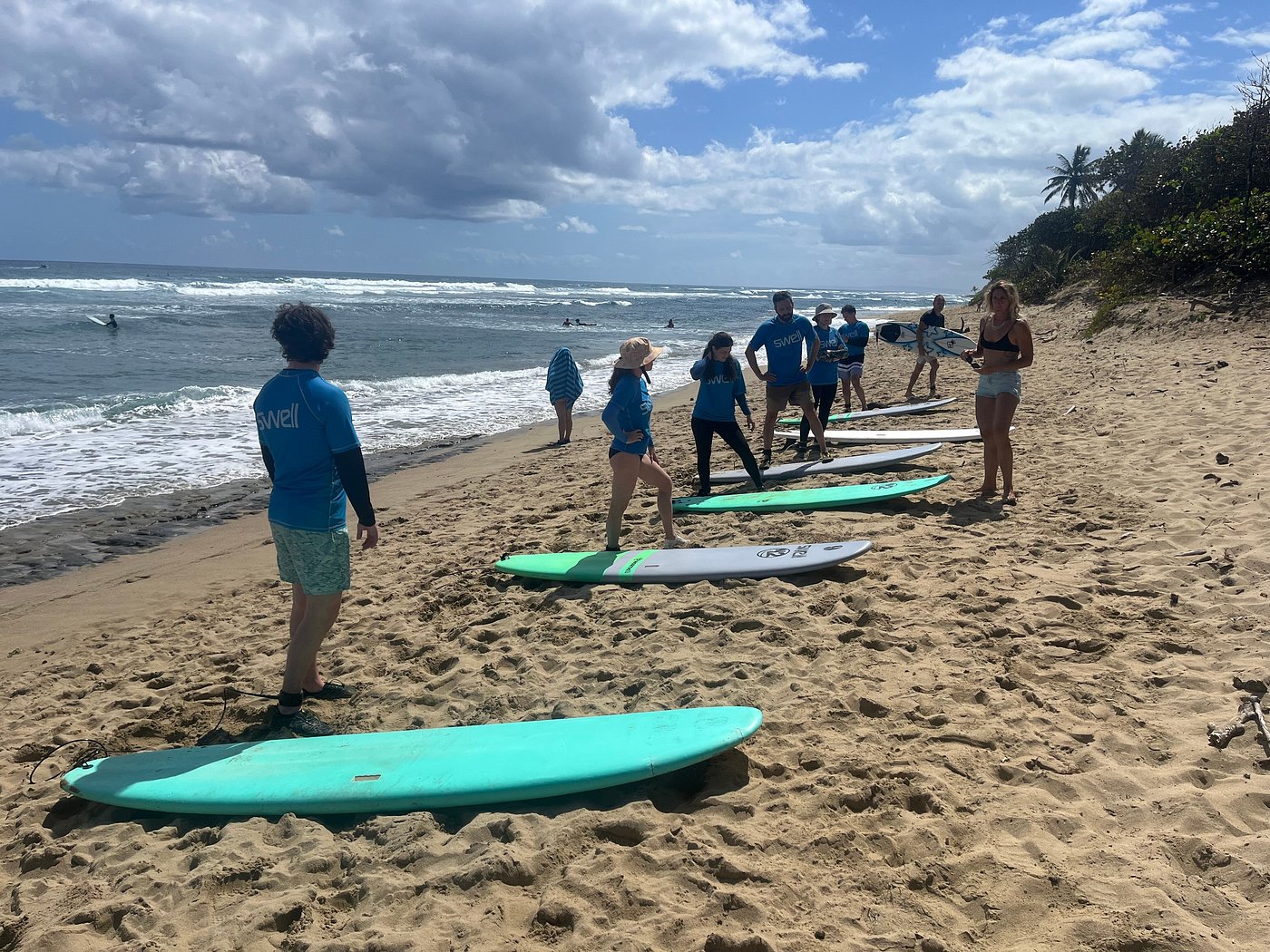
You get around seven sessions across a week, roughly two and a half hours each, with about half of that under direct coaching and the rest practising what you were just shown. Here is the shape it usually takes. Yours will wander off this, because everyone’s does.
Day 1
You stand up. Beach theory, safety, then whitewater. Around 95% of adult beginners get to their feet in this first coached session. It will be wobbly and it will not feel like surfing yet. It counts anyway.
Day 2
Your body complains. Shoulders and ribs, mostly, from paddling muscles you have never used. You will also stand up more reliably than yesterday. Both things are normal.
Day 3
The hard one. This is the day people go backwards, overthink the pop-up, and quietly decide they are the one person who cannot do this. It happens to almost everybody and it passes. Our coaches watch for it. If you only remember one thing from this page, remember that day three is a stage, not a verdict.
Day 4
It clicks. Paddling gets stronger, you need less pushing, and you start reading where the wave is going to break instead of waiting to be told.
Days 5–7
Depends on the ocean. Some guests move onto unbroken green waves. Some spend the week in whitewater getting properly good at it. Which one you get is mostly down to conditions that week, not to you.
A word on green waves. Plenty of camps promise you will be riding unbroken waves by Friday. We will not, because it depends on what the ocean does that week and we do not control that. What I will say is that the standing-up part is close to a certainty, and the rest is a good bet in the right conditions. If you want the detail, we wrote about catching your first unbroken waves separately.
The board matters more than your age
Board volume is the single biggest lever for an older beginner. A bigger, thicker, softer board floats you higher, catches waves earlier and forgives mistakes. Almost every adult who struggles to learn is struggling on a board that is too small, not because of their age.
If you are booking lessons anywhere, ask what they will put you on before you pay. A rough starting guide by body weight:
Your weight
Board length
Why
Under 70 kg / 155 lb
7’6″ – 8’0″ soft-top
Stable, and still easy to carry down the beach
70–85 kg / 155–187 lb
8’0″ – 9’0″ soft-top
Good glide, catches waves with less paddling
Over 85 kg / 187 lb
9’0″ – 10’0″ soft-top
Maximum float, most forgiving of a late pop-up
Ignore anything short and good-looking for now. It will cost you the week. Our full guide to beginner surfboards goes deeper if you are thinking about buying one for home. If you learn with us the board is matched to you and included, so this is really advice for anyone booking elsewhere.
How to prepare, and what not to bother with
The advice you will read everywhere is to get fit first. I would put it differently: do not wait to be fit, and do not train for surfing specifically. Nothing on land properly rehearses paddling, and people who spend three months preparing tend to arrive with expectations that get in their own way.
Two things are worth doing in the weeks before you come.
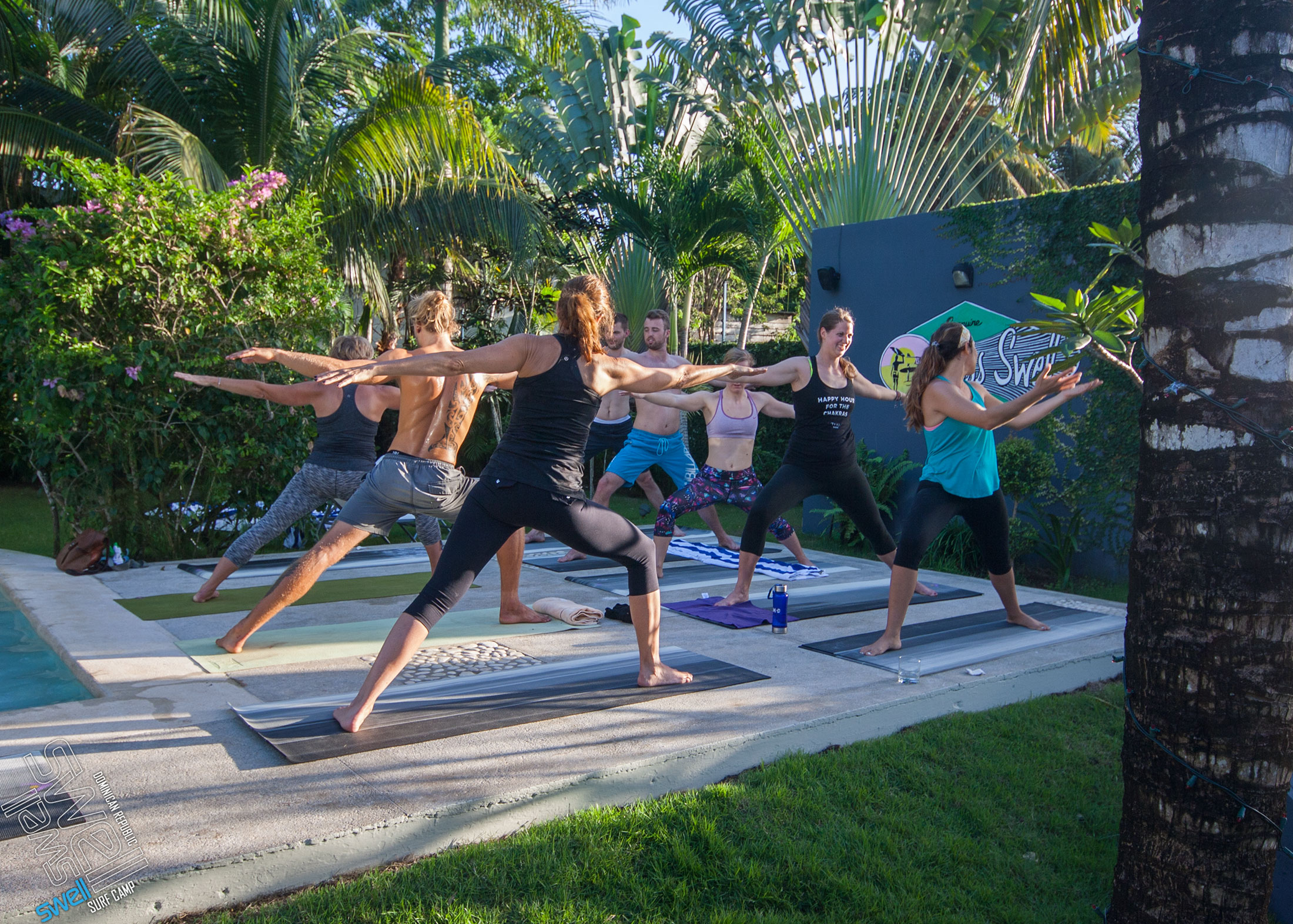
Loosen your hips, ankles and shoulders. This is the one that genuinely changes your first day. The pop-up is a controlled squat under load, and stiffness there costs more than weak arms ever will. Twenty minutes of stretching most days beats an hour in the gym twice a week. Our surf fitness exercises are a simple place to start, and the yoga sessions during your week are aimed squarely at the same thing.
Swim, ideally in open water. Not for fitness. For calm. Being tumbled by a small wave is completely harmless and briefly disorienting, and having done something similar before means you laugh instead of panicking.
Beyond that, come with a sense of humour and low expectations for day one. Both are more useful than any workout plan. The surf level guide is worth a skim if you want to picture where you will start.
The physical case for it is real, incidentally. The American Heart Association’s activity guidance asks for 150 minutes of moderate movement a week, and a single morning surf covers a good share of that before breakfast. The Mayo Clinic’s work on exercise and mood covers the other half of why people come off the water lighter than they went in. Neither is why anyone books, but both are true.
Clare started at 52
“I had run a surf camp for years and never particularly wanted to surf. Then at 52 I thought, this is ridiculous.”
Clare, co-owner of Swell
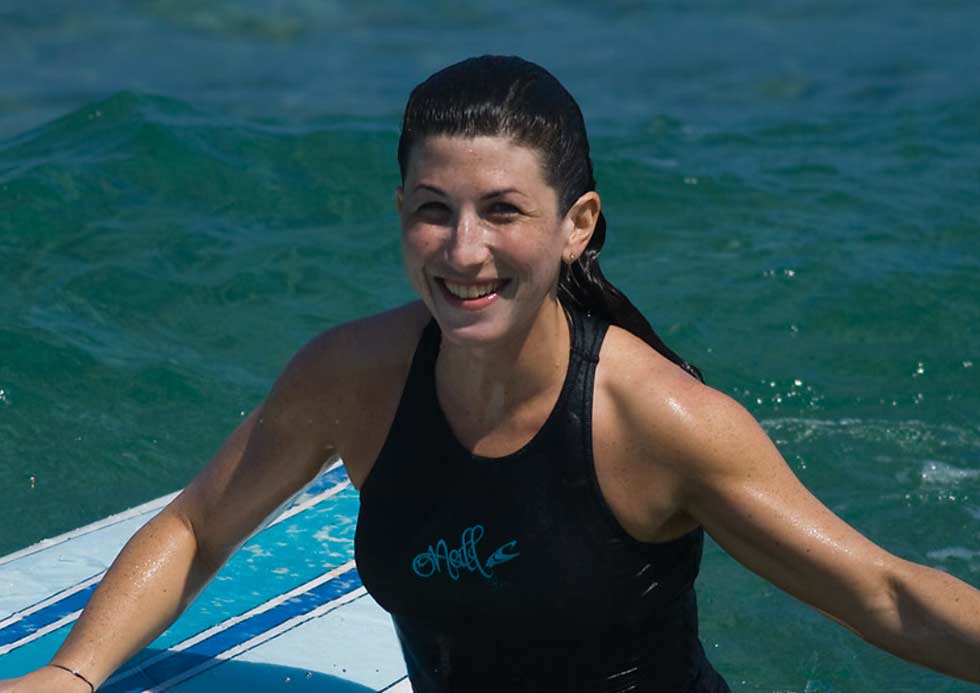
My wife Clare co-founded this place and spent well over a decade around surfing without any real interest in doing it herself. She started at 52. She is 56 now and paddles out with her own group of surf friends whenever the day allows, and she is faster to the water than I am most mornings.
Clare surfing
I mention it because she had every excuse available. She was surrounded by good surfers, which is intimidating rather than encouraging. She had watched thousands of beginners and knew exactly how awkward the first week looks. She did it anyway, in her fifties, and it took.
Where you learn matters more than when you start
For an adult beginner the destination does more work than anything else. You want warm water so falling is pleasant, small gentle waves over sand, no crowds fighting you for position, and a short transfer so the week is spent surfing rather than travelling.
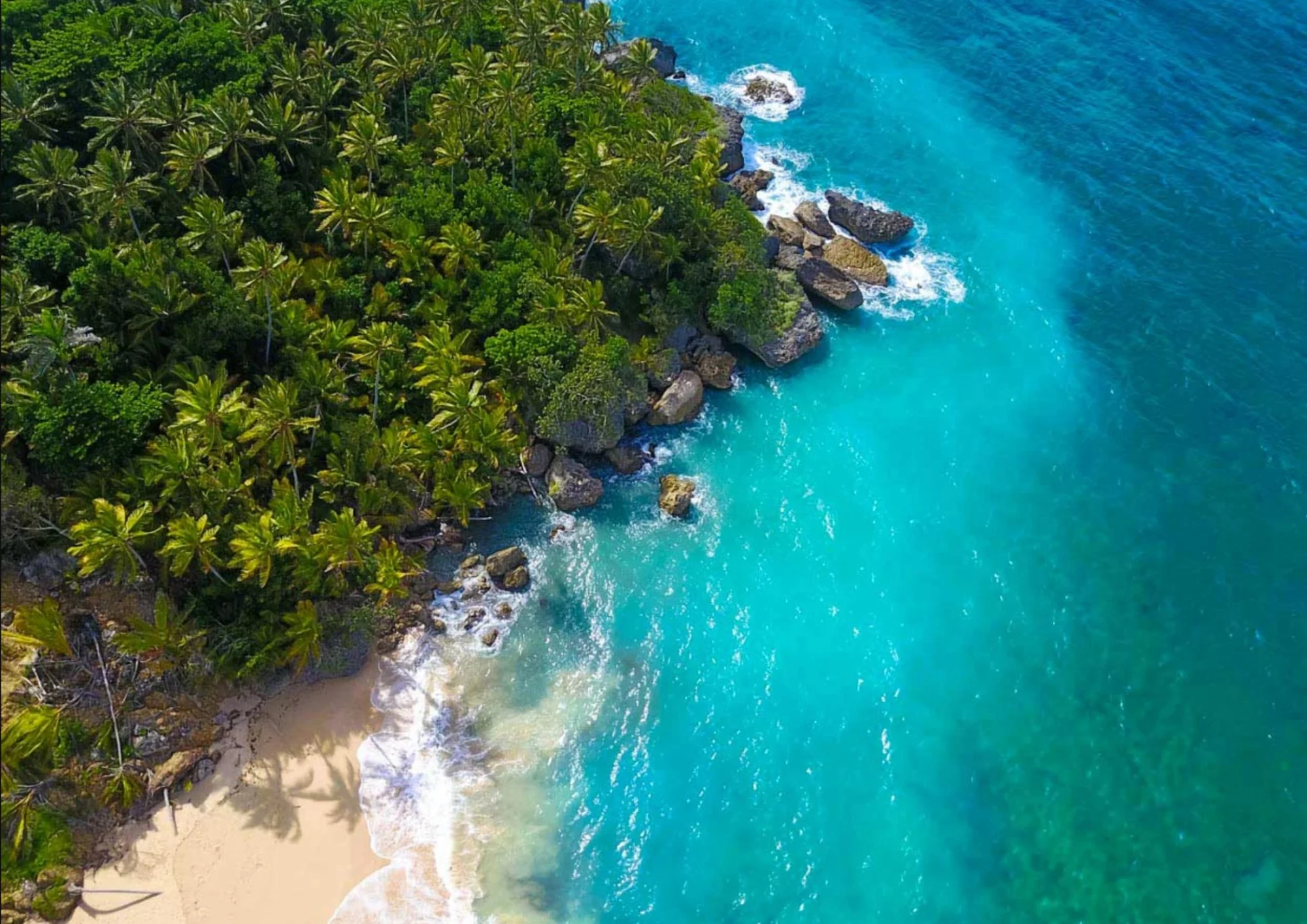
We looked at a lot of places before choosing Cabarete, and the reason we stayed is Playa Encuentro. The beginner section is inside, roughly chest-deep, over a flat limestone floor that is mostly covered in sand. No sharp live coral, no rip pulling you out, nothing that punishes a beginner for being in the wrong spot. The water sits around 27°C, so no wetsuit and no cold-shock nerves.
The other piece is that Encuentro has several peaks along the same beach. You will not outgrow it in a week, or in five years. And it is 25 minutes from Puerto Plata airport, which sounds like a small thing until you compare it with the four-to-eight-hour road transfers common in Costa Rica.
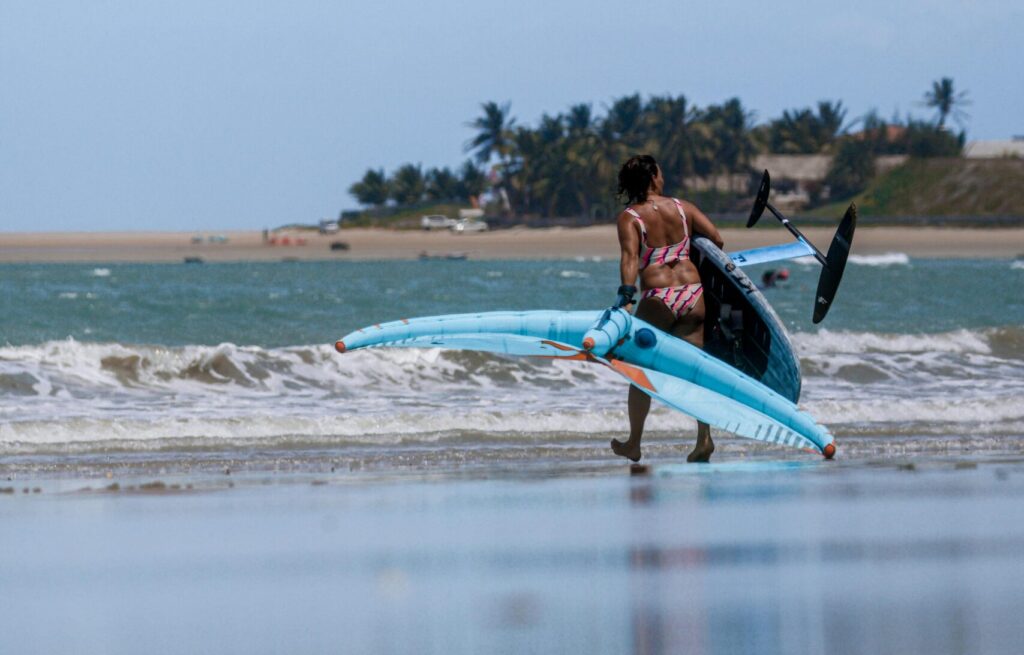
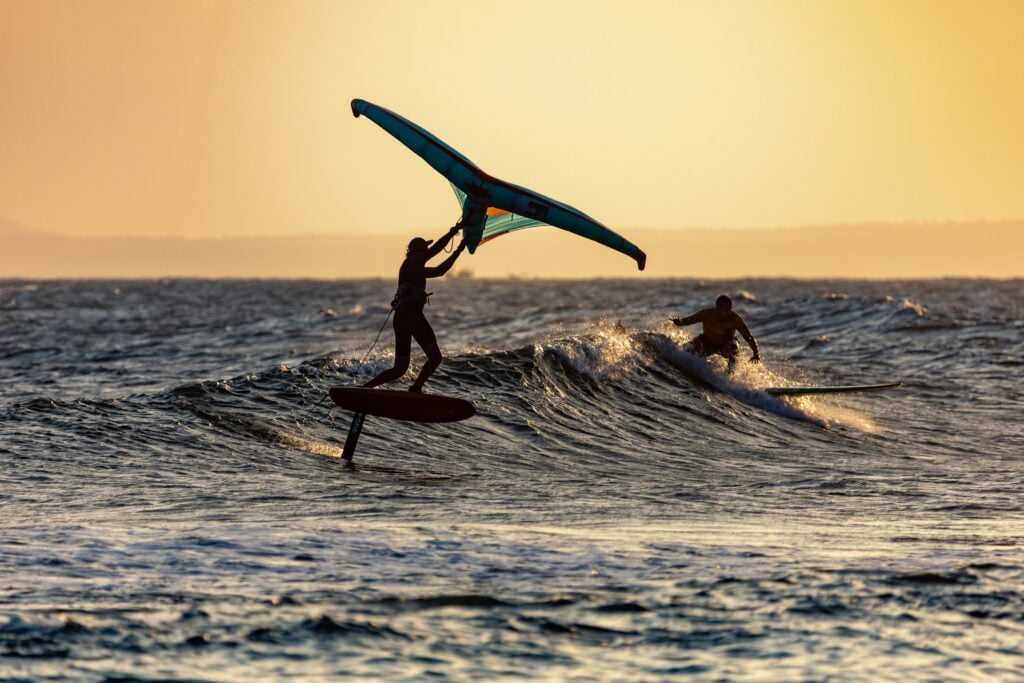
One alternative worth knowing about: if paddling is the part you are unsure of, wingfoiling asks much less of your shoulders and has become the thing a lot of our over-50 guests switch to. We wrote separately about wingfoiling in your 40s and 50s.
Questions we get asked most
Is 40 too old to learn to surf?
No. Forty is a common age to start, and we teach people in their 50s and 60s every season. Surfing depends on balance, timing and board choice rather than youth. Around 95% of the adult beginners we coach stand up in their first session, and our average guest is 39.
Can you learn to surf at 60?
Yes. Shoulder endurance is usually the limiting factor at 60, not balance or nerve, so a high-volume soft-top board and shorter sessions make the difference. Progress is steadier than it is for a 40-year-old, and most people in this age group end up enjoying longboarding rather than chasing steeper waves.
How long does it take to stand up on a surfboard?
Most adults stand up in whitewater during their first coached session. Riding unbroken green waves takes longer and depends heavily on the conditions during your week, so we avoid promising it by a particular day. Consistent daily sessions matter far more than natural ability.
What surfboard should an older beginner use?
A large soft-top, typically 8 to 10 feet depending on your weight. More volume means more float, earlier wave catching and far more forgiveness when you are slow to your feet. Avoid short boards entirely until you are well past the beginner stage.
Do I need to be fit to start surfing after 40?
No, and we would rather you did not wait until you feel fit enough. You need to swim confidently and be in ordinary health. Mobility in your hips and shoulders helps more than strength, so stretching in the weeks beforehand is the one preparation genuinely worth doing.
Is surfing safe for older beginners?
Learning in shallow whitewater on a soft board, with a coach choosing your waves, is low risk. Surfing is non-contact and low-impact, which is kinder to older joints than most land sports. At Encuentro the beginner section is chest-deep over sand-covered limestone with no rips, which removes most of what people are actually afraid of.
Come and find out what you can do
Sixteen guests at a time, coaches who have taught thousands of adults their first wave, and warm water that makes falling in genuinely enjoyable. Tell us roughly when you would like to come and we will send you availability and a price.
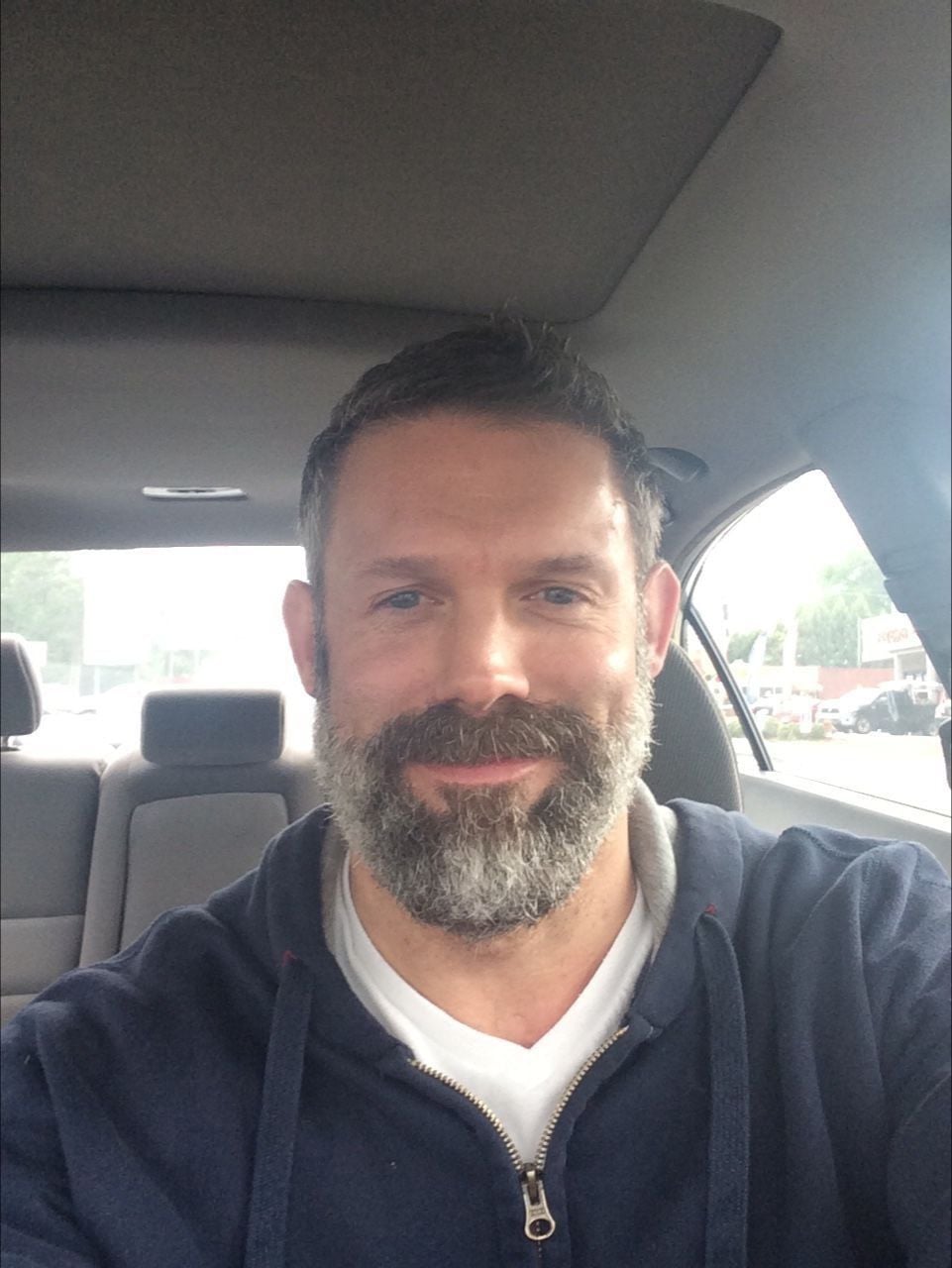
Jeroen co-owns Swell Surf Camp in Cabarete with his wife Clare and has been teaching adults to surf and wingfoil on the north coast of the Dominican Republic since 2009. A lifelong waterman across surfing, wingfoiling, windsurfing and kitesurfing, he has helped several thousand first-timers catch a wave, a great many of them over 40. More about Jeroen.
If I could give Swell 10 stars I would!! My partner and I visited Swell at the end of March 2026. We had an absolutely amazing trip. The rooms are clean and spaceship. The A/C works great and had warm water to shower. The WiFi is spotty in the upstairs rooms but works perfectly in the downstairs communal room. The staff is above & beyond!! The meals were some of the best I’ve had. The surf instructors are phenomenal.. they work with your experience and levels of surfing and join you for breakfast & dinner nights. The yoga is great mostly long holds and stretches which are great after 2 sessions of surfing. Haudy is the best. She runs the place and without her Swell wouldn’t be Swell. I highly recommend doing the canyon tour with Helmut. And last but not least the people that I stayed there with honestly became my family for the week. I honestly want to come back!
Tripadvisor April 2026
Plan a tripjoin us at Swell
POP
25 Min
SWELL
swell
Easy travel → arrive any day of the week
Watersport paradise
Tell us your dates, how many people you are thinking about coming with, and we’ll send you a custom price and availability quote; almost instantly. Hasta pronto, see you soon.
Jeroen Mutsaars co-founded Swell in 2009, building the retreat in Cabarete from bare land with his wife Clare after years running a European surf travel company. Fifteen-plus seasons on the beach, six watersports ridden himself, and several thousand adult beginners coached from their first wave onward.