
UNDERSTANDING SURF FORECASTS
Decades have passed since surf travel has required reading nautical charts, packing weather radios, and crossing your fingers that your destination had some trace of swell. Gone are the days of surf exploration, where any hidden stretch of coastline could possess the often sought after—yet rarely found—perfect wave. Today, we open our phones and we are able see what the surfs doing anywhere in the world in a matter of seconds.
Regardless of the local of your session, surf trip or not, getting skunked burns the same. Surf and weather forecasting might be the most advanced it has ever been, but it will do no good if you’re not quite sure how to read a forecast. Can you say without a shred of doubt that you understand the relationship between swell interval and wave size? Do you know what swell directions the best for your local break?
Can you track a swell originating halfway around the world until it makes landfall on your coast? At Swell Surf Camp, we want you to prepared and knowledgeable surfers, whether you’re surfing at our Caribbean surf resort, or at your home break. Keep reading to learn how to read and interpret surf forecasts and you’ll be sure to score on your next trip down the coast or across the world.
WAVE HEIGHT
Wave height, it’s pretty self explanatory . Simply put, it is the height of the wave. Understanding the mix of variables that affect a wave’s height will improve a surfer’s ability to read a forecast, and ultimately lead to catching more waves. First, it is important to know that the forecasted wave height, and the height of a wave’s face are typically different. Waves are measured from the top of the peaking swell, which is not the same thing as the face. So, a 2-foot forecast on an offshore day, with the right ocean floor contour, can produce a 3 to 5-foot face.
The forecast might read 2-3 feet, but the waves face could easily be head high.

SWELL INTERVAL
Failure to comprehend and properly read swell interval can lead to missing a solid surf session. Swell interval is defined as the time that passes between two waves, typically measured in seconds. Swell interval has a direct relationship to wave size in that a long interval will produce larger surf.
The concept is simple. If a wave has a long interval, it has more time to build in size. Thus, along swell interval or period —as it is often called— will create bigger surf than a short interval on with the same size swell. Longer interval swell will also produce more powerfull breaking waves.
SWELL DIRECTION
Swell direction is another term with a self-explanatory title, it is simply the direction of the incoming swell. A swell’s direction is categorized by the direction the swell is traveling from, rather than the direction of that swells trajectory.
A swell traveling from south to north would be labeled as a south swell. How swell direction affects wave quality depends what direction the coast/ break is facing and the wind direction. If a beach is facing southwest and the incoming swell is a northwest swell, the resulting conditions will most likely be choppy.
The most common Swlel direction on the North Coast of the Dominican Republic is North East, but in winter time when stronger storms are off the coats of New Work it will send waves down to the North Coast of the DR in a good North Swell. A typical North Swell in The DR will be 6 foot in height with a 13+ second interval, resulting in waves overhead to double overhead in Cabarete
WIND DIRECTION
Wind direction will always make the difference between average waves and great waves. If the wind is blowing onshore (towards the beach) it will flatten waves and cause chop. If the wind is blowing cross shore, it will create shop and poor wave conditions.
If the wind is blowing offshore, however, it will prop up the face of the wave and create clean surf conditions.
WIND SPEED
Regardless of what direction the wind is blowing, high wind speeds will create more difficult surfing conditions. A gentle wind is an ideal scenario for surfing. If the wind is blowing onshore, but only at a speed of 3 or 4 mph, then the conditions will most likely still be clean.
Even if the wind is directly offshore, high wind speeds will make it difficult to drop into waves.
TIDE
While some breaks work at all tides, not all breaks are created equal. In the same vein, some breaks work well at high tide and others exclusively at low tide. The deciding factor has to do both with swell/ wave size and the ocean floor contour.
For example, certain reef breaks may only be safe to ride at high tide because the reef could be exposed or too shallow at low tide. Similarly, some sand bars may be too deep to effectively cause waves to break during high tide, but they may work well during low tide.
Fortunatly for us, there’s very little tidal change on the beaches of the North Coast, so you can surf in all tides
VIDEO EXPLAINING THE DIFFERENT ELEMENTS

WAVE TYPE
While the wave type of any given break does not fluctuate and is not technically part of your daily surf forecast, it is usually included in a small section to help you better comprehend how the wave breaks on any given day.
There are three main wave types: beach break, reef break, and point break. Each wave type can produce a left, a right, or an “A-frame” depending on the set up of the break.
BEACH BREAK
A beach break is the ideal learning setting for any beginner surfer. Beach breaks have sand floors, meaning that they have surfers who hit the bottom have a low risk of injury. Waves break over sand bars (rather than reefs), which can shift significantly during a day creating several peaks.
Additionally, wave energy pounds into the sand and has nowhere to go but up and out, which creates an arduous paddle out during a large swell.
REEF BREAK
A reef break is any wave that breaks over some type of submerged rock formation. There are a variety of types of reef breaks, some of which are beginner/ intermediate friendly and some of which that are advanced only.
SUBMERGED REEF
A submerged reef break is the only variety that could be considered beginner to intermediate friendly. While every beginner surfer should start out on a beach break, once they have mastered the pop-up and are able to successfully ride down the line at will, riding a submerged reef break is not out of the question.
A submerged reef break is not a live coral reef, the ocean floor is made up of rock that has been covered by sand. While you don’t’ necessarily want to get slammed into a submerged reef, you won’t hurt yourself by walking on it.
CORAL REEF
Coral Reefs are, are full of, living organisms. Coral is sharp, simply stepping on coral can cause injury. Additionally, many coral reefs can be full of sea urchins that’ll ruin any surfer’s day. Coral reefs, regardless of the depth of water at the break, should only be surfed by intermediate to advanced surfers.
ROCK REEF
Similarly, rock reefs can put a serious damper on your day if you come into contact with them during a wipeout. While the rocks may not be sharp (they often are though), they may still be riddled with sea urchins just waiting to impale you. Depending on the depth of water over the reef, rock reefs should only be ridden by intermediate to advanced surfers.
POINT BREAK
Point breaks cater to surf progression. Point breaks are generally slow breaking, mellow rides that often offer up ideal sections for carving and turning. A point break is caused by an obtrusive land or underwater mass—often rock— that runs perpendicular to the wave/shoreline.
The protruding mass will cause the peak of the break to present itself at roughly the same place every single wave, which can crowd the lineup, but offers workable sections for intermediate surfers looking to improve.
Armed with the newfound knowledge of an amateur meteorologist, you are ready to take to the sea, plan your next surf trip to Swell Surf Camp, or drive down to the coast to catch some waves!
WAVE FORECASTS FOR THE DOMINICAN REPUBLIC
The surf forecasts we use the most in Cabarete are and Windguru (opens new window) which is very reliable for wave and wind forecasts for surfers and kitesurfers.
In need of good waves?
At Swell we provide Learn how to surf holidays for people that have never surfed before as welll as a great social place to stay for advanced and expert surfers looking for a cool, comfortable & social place to stay. We offer full packages which include:
- Airport transfers
- Breakfast and 4 dinners
- Comfortable & stylish accommodation
- surfboard rentals and surf transport
- A great social vibe
 We hope to see you in the Dominican republic soon


 One of the majorities of mistakes that beginners, intermediate and even some experienced surfers make is the poo stance.
 Big wave surfing also requires the same rule. To maintain balance, reduce the risk of blotting out, and take in unforeseen bumps, extreme surfers have the tendency to crouch.
 Unless there is pressure from the back foot heel and toe, the board will never make the right turn. Your back foot acts as the accelerator pedal. Although your front foot has no effect on the turning process, it offers you balance.
 Even after application of back foot pressure, a few individuals still have difficulties with making a turn due to the fact that their foot has moved too forward. A back foot traction pad is excellent equipment because it allows you to know the specific position of your foot.


 Looking at the wave coming at you, the left side is called a “right” because you go right when you surf it. The right side is called a “left” because you surf it to the left.
 This may seem obvious, but the simple push-up is a highly effective, yet often overlooked, tool for building upper body strength and endurance. The good thing about the push-up, as with any bodyweight exercise, you won’t build bulky, excess mass.
 Like the pushup, the pull-up is another phenomenal bodyweight exercise that will build functional strength relative to one’s body weight, not bulky, unnecessary mass, so an ideal surf fitness exercise. Similarly to how we described the pushup, with the pullup we want to build our rep capacity.
 Often used as a scaled-down pull-up substitute, inverted rows are a great way to strengthen your lats, the small muscles in your upper back, and your rear deltoids (all paddle muscles). As stated previously, if you cannot do a pull-up, inverted rows are a great place to start. To perform lay horizontally below a suspension trainer or secured barbell. The higher off the ground the suspension trainer/barbell, the easier the exercise will be.
 Handstand push-ups might sound intimidating, but they are not as difficult as they may look and they have a myriad of benefits that will directly improve your surfing. Handstand pushups target your deltoids, which are used heavily when we paddle. What makes Handstand pushups superior to any old overhead press, for surf training specifically, is that like the aforementioned push-up and pull up, handstand pushups build lean muscle and functional strength relative to one’s body weight.
 For those not quite ready to kick up onto a wall and crank out handstand pushups, the pike push-up is the ideal substitute.
 The small muscles in our back our crucial for paddle endurance, but they are often overlooked in training. Fortunately, it doesn’t take much to keep your rhomboids and surrounding muscles fit. You don’t need to use a lot of weight, in fact, you only need to use a fraction of your body weight. Suspension trainer rear delt flies are a great way to train these muscles and you can do it virtually anywhere.
 If you’re looking for an intense way to train explosiveness, like that required in a
  This exercise is a tad more advanced than some of the others, but if executed properly and regularly, it will enhance your surfing ability. The Bosu Ball is a unique piece of fitness equipment that allows you to train strength and balance simultaneously.
 The erg machine might be the best piece of equipment in the gym for total body surf training. Rowing recruits massive amounts of lower body strength, arm and back strength, muscle endurance, and heavy aerobic activity. Whether you’re training to paddle hard, toss buckets on turns, or to last hours in the lineup rowing is the exercise for you. To start, try rowing 1000 meters for time.


 Many may recommend snowboarding here, and whilst practicing another board sport is an excellent way to prepare for the open water, skiing just adds that extra dynamic of having your feet move more freely. This is something which absolutely helps to improve your focus, and given the unpredictability of the waves on occasion, we feel like I is a similar match for that of the mountain and the obstacles which it presents.
 It seems like an obvious selection, but as a reminder to some who may have overlooked it, swimming is the most important skill which any surfer must possess. It is after all a water sport, and you will indeed find yourself in the ocean on more occasions than you may expect. This is key through all stages of your surfing development. As you start to become more accomplished, sure you become a better surfer, being a top quality swimmer suddenly becomes all the more important.
 This next training technique is a bit of a curve ball for many. Dancing can have a number of benefits to see you reach peak performance on the board. How is that possible? – Movement. This movement and most importantly coordination with your partner in dancing, can easily transfer across onto the board. Knowing where your feet are positioned at all times is vital when boarding and dancing.
 This is a broader concept, but staying upright on a surfboard requires a lot of core strength. Not only that, but getting back up on to your board and keeping your balance are all centered on the core of the body. Therefore, anything you can do to boost your core strength will result in positive results in the swell.
 What better way to boost that core strength we just mentioned than engaging in one of the trending exercises of the moment. CrossFit training will absolutely help boost your core strength and that of the rest of your muscle groups whilst also promoting and improving agility. There is so much crossover here which can help you with your surfing performance that most top guides nowadays would actively encourage registering yourself with a CrossFit program.
 When we talk about movement, agility, and flexibility, we absolutely must give a mention to calisthenics. This makes us focus on all of those areas and boosts a number of the areas which we have already discussed. This attention to bodily movements and the amazing boost which some of the workouts will give you raw core strength is vital if you want to take to the waves and be the best that you can be.

 1. Nose
 Rocker
 Concaves
 Tail.
Tail. 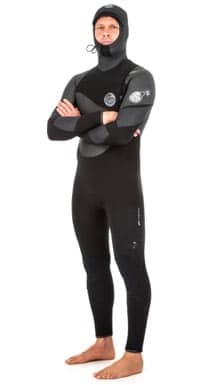 Come in various thicknesses, usually indicated by numbers separated by a forward slash, a 5/4 for example, where the first number indicates the thickness (in mm.) of rubber on your core (torso) and the second number indicates the thickness of the neoprene rubber on your arms and legs. Thicker wetsuits means less flexibility, but thinner wetsuits are not as warm.




 Learning to surf is far more than starting a new sport and acquiring the skills necessary to compete.
 While this may sound a tad condescending, understanding your own abilities in the water and humbly accepting them could save your life. If you’re still learning and you paddle out at an advanced wave, whether that’s a shallow reef break or any break on an overhead day, you run a high risk of injuring yourself and endangering those around you.
 The most important thing to know when paddling out at a crowded line up is that the paddler yields to the riding surfer.
 If paddling wide is not an option, then aim for the white water of the wave, instead of going and aiming for the easier option of the shoulder of the wave ( where the surfer is)
 No, you’re not surfing a WSL heat, but priority still exists at every surf break. To put it simply, the surfer closest to the peak of the wave has priority over the surfer who is farther from the peak or on the shoulder. Understanding priority is key to existing peacefully in a crowded lineup.
 This may seem like a no-brainer, but it happens often. A surfer is riding down the line when all of the sudden, another surfer appears on the wave and tries to hop to their feet.
 When a wave breaks both left and right, two surfers can happily ride the same wave, just make sure to communicate by announcing if you’re going right or left, even if you think it’s obvious. A little communication in the water can do a lot to keep everyone safe and having fun.
 Most surf injuries are not caused by the seafloor, other surfs, or wildlife, they are caused by surfboards. Surfboards are rock solid and have sharp fins, they can do some serious damage.
 Laird Hamilton recalls, “I got run over by a guy when I was sixteen and he broke my leg. A guy ran me over with a giant longboard, and it compounded my leg, and that was one of those things that you learn, like, ’Don’t trust that the guy sees you and that they’re going to avoid you.’ Just remember that they’re probably going to run you over if you don’t watch where you’re going.”


 How to perform Upward Facing Dog:
 How to perform Downward Facing Dog:
 How to Perform Bow Pose:
 How to perform Locust Pose:
 How to Perform Balancing Table:
 How to perform Extended Puppy Pose:
 How to perform Cow Faced Arms:
 How to perform Four Limb Staff Pose:
 How to Perform Kneeling Crescent Lunge


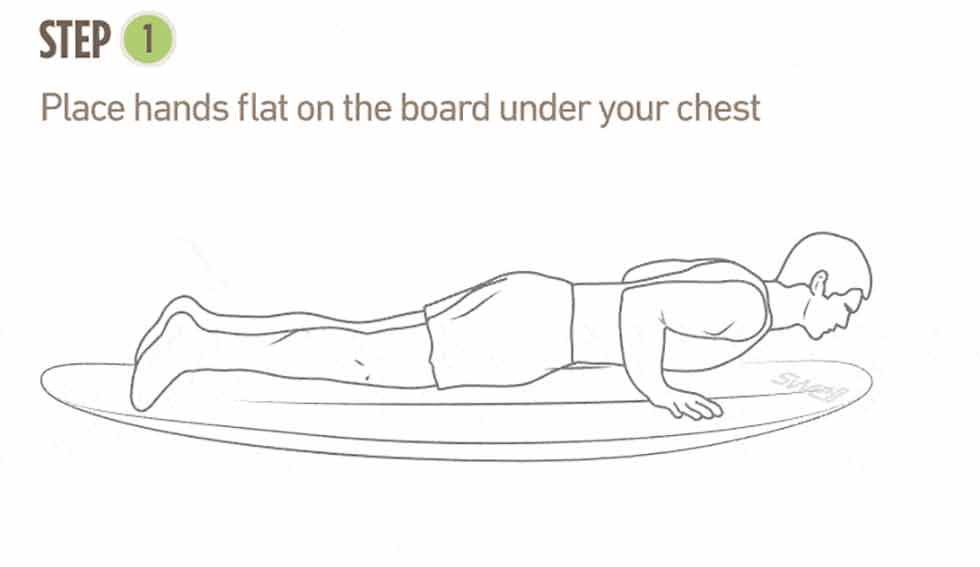
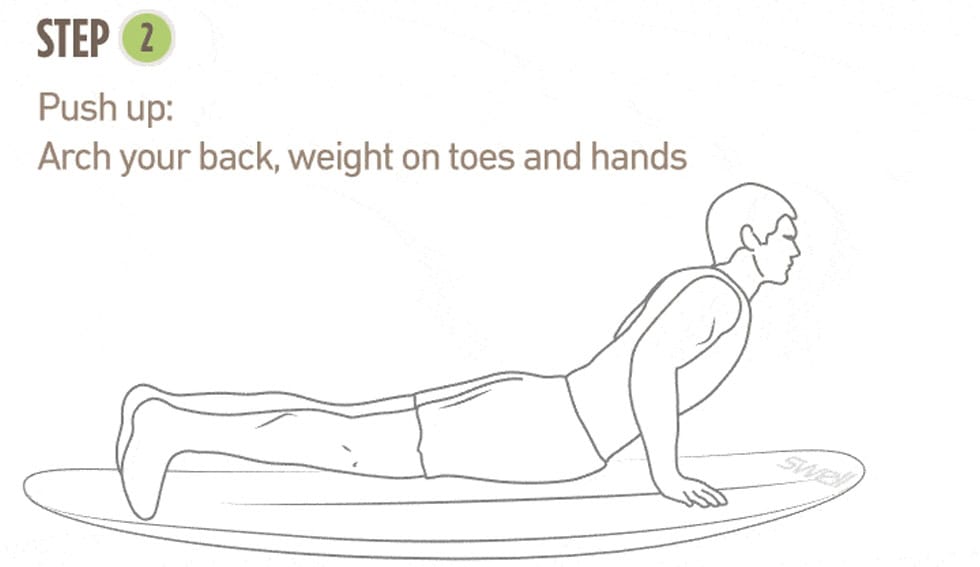
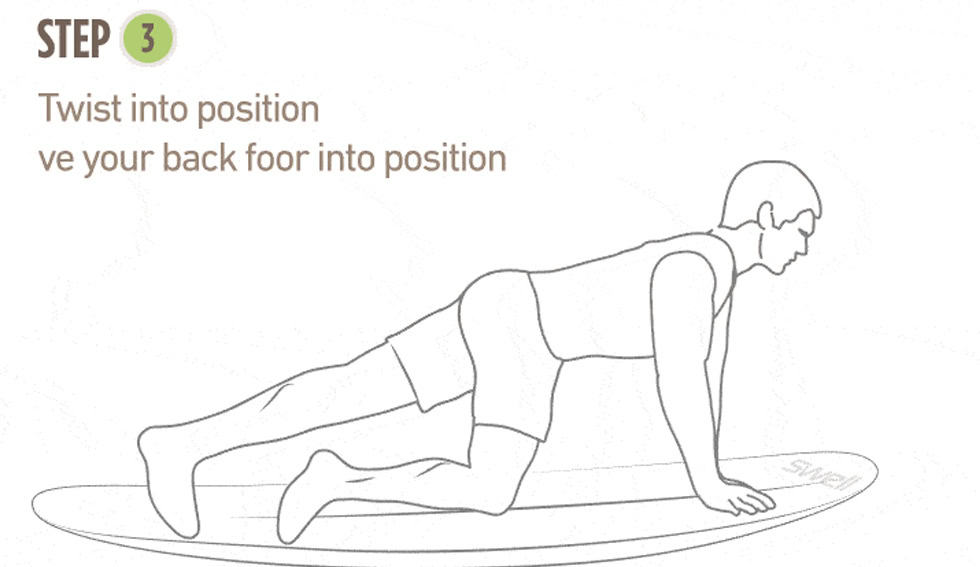
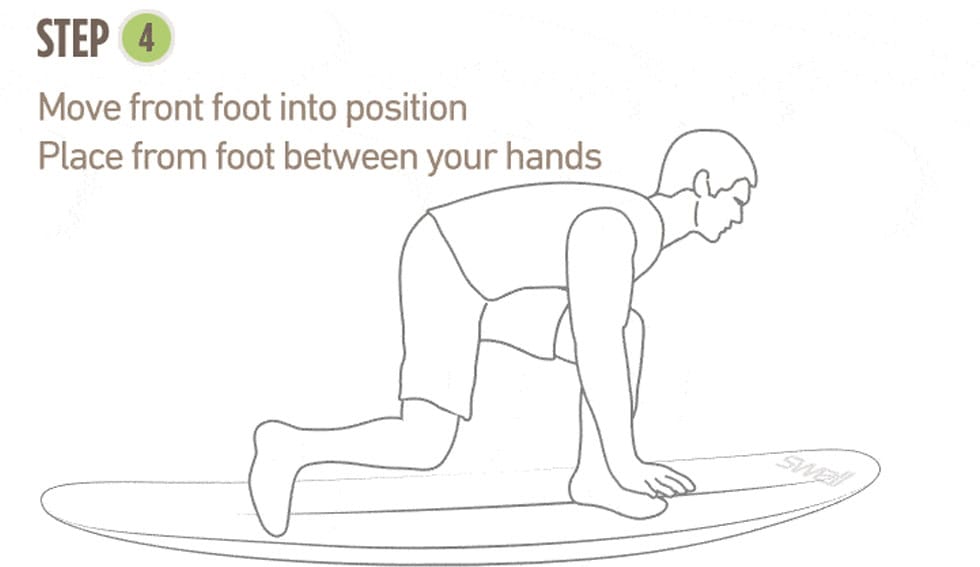
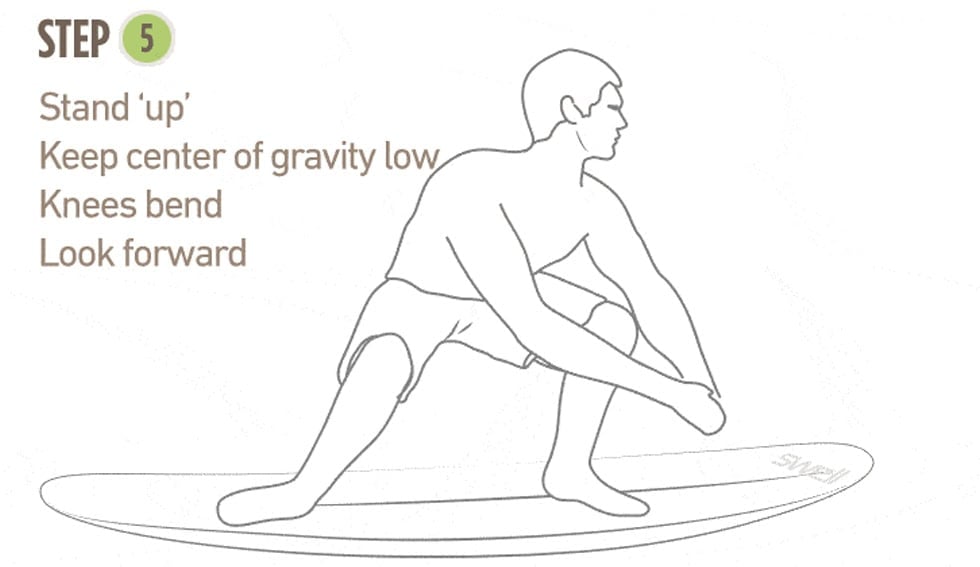


 Practise on the wrong waves: the pop up technique should be practised in small white water waves, not out in the lineup (out the back) for first-time surfers. Don’t go out in big waves, or crowded surf spots.
 Use a big soft top surfboard. Sure those little boards look cool, but learning on a board that is too small will make learning to surf far harder and will take you forever. Big soft tops are stable and safe.




 TOW BOARD
 FISH SURFBOARD
 SHORTBOARD
 HYBRID
 MINI GUN (OR STEP UP)
 EGG
EGG MINI MAL
 LONGBOARD
 BIG WAVE GUN (aka. RHINO CHASER)

 A longboard is anything 9 feet and over. Traditionally, longboards have single fins, but now it is common to see longboards with a “two plus one” set up. Meaning two thruster style fins with a traditional large single fin in the middle.


 A groveler may appear to be just a standard shortboard, but upon closer inspection, you will find that a groveler is typically shorter and stubbier than the average high-performance shortboard. What this means is that while grovelers may be ridden at a reduced length, they have an increased width, thickness, and therefore more volume than normal shortboards.

 The fish is an immensely popular shape that has been around since the 1970s. Fishes have a few defining characteristics that separate them from normal shortboards or grovelers. The most notable characteristics of a fish are the wide swallowtail and the twin fin (often keels) set up. Fishes also tend to have a lot of volume under the chest and somewhat flat rockers.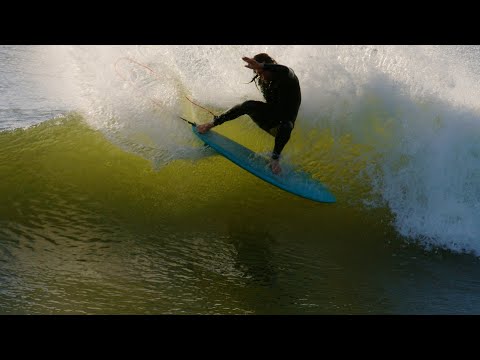
 High-performance shortboards vary in size from about 5’4” to 6’8.” They are designed for one thing and one thing only, to turn on a dime and make the absolute most out of the open face of a wave. A good high-performance shortboard will allow surfers to fit as many turns possible into a wave while maintaining speed and control.
